Leadership insight
Shaping the future of transportation funding
Transportation agencies must adopt innovative funding models and data-driven planning to bridge infrastructure gaps. By leveraging diversified revenue streams and integrated capital strategies, they can improve investment outcomes and ensure long-term system sustainability.


After decades in the transportation sector, I have witnessed how persistent underinvestment and outdated funding models have eroded our infrastructure. While innovation transforms mobility, we remain shackled by aging systems, declining revenue streams, and fragmented policies that hinder adaptation to a modern economy. The inconsistent adoption of new funding sources and lack of coordination among states have created a critical shortfall, affecting highways, bridges, and public transit. Transit networks cannot expand or modernize without regional funding mechanisms, particularly in urban areas where economic growth depends on safe, reliable, and affordable transportation. This funding gap has led to maintenance delays, cost overruns, and deferred projects, further deepening the infrastructure crisis. The need for transformative, stable funding models has never been more urgent.
Possible revenue solutions for transportation funding
The Infrastructure Investment and Jobs Act (IIJA) has started addressing long-standing underinvestment in transportation. However, the Highway Trust Fund’s ongoing insolvency and uncertainty about future funding highlight the need for enduring solutions.
With traditional revenue streams declining, adopting innovative funding mechanisms is essential to ensure long-term financial support for highway and transit projects.
Key strategies include:
- VMT fees: Charge vehicle users based on miles traveled to ensure an equitable contribution towards infrastructure funding. Oregon was the first state to implement the revenue method in 2015, followed by Utah in 2020, and other states are now beginning to adopt similar programs as well.
- Managed lanes: These use dynamic toll pricing based on traffic conditions to manage congestion and generate additional revenue. They are used predominantly in Texas, California, Colorado, Minnesota, and Florida.
- Public-private partnerships (P3s): Mobilize additional capital and expertise for infrastructure development and risk sharing. Virginia partnered with Fluor Corporation and Transurban, both transportation-infrastructure firms, to expand I-495, the Capital Beltway, with High Occupancy Toll (HOT) lanes, retaining ownership while granting an 80-year operations concession.
- Highway monetization: Lease or sell assets to private entities and enable tolling on existing highways to fund new projects. In 2006, Indiana leased the Toll Road to the Macquarie-Cintra, a global infrastructure consortium, for 75 years, securing $3.8 billion for highway upgrades and privatizing operations.
- EV charging revenue: Invest in charging stations with public-private partnerships to reduce public expenditure and accelerate network expansion. Washington State is building EV charging stations on five major arterials, with private partners covering costs and operations while the state provides sites and potential funding.
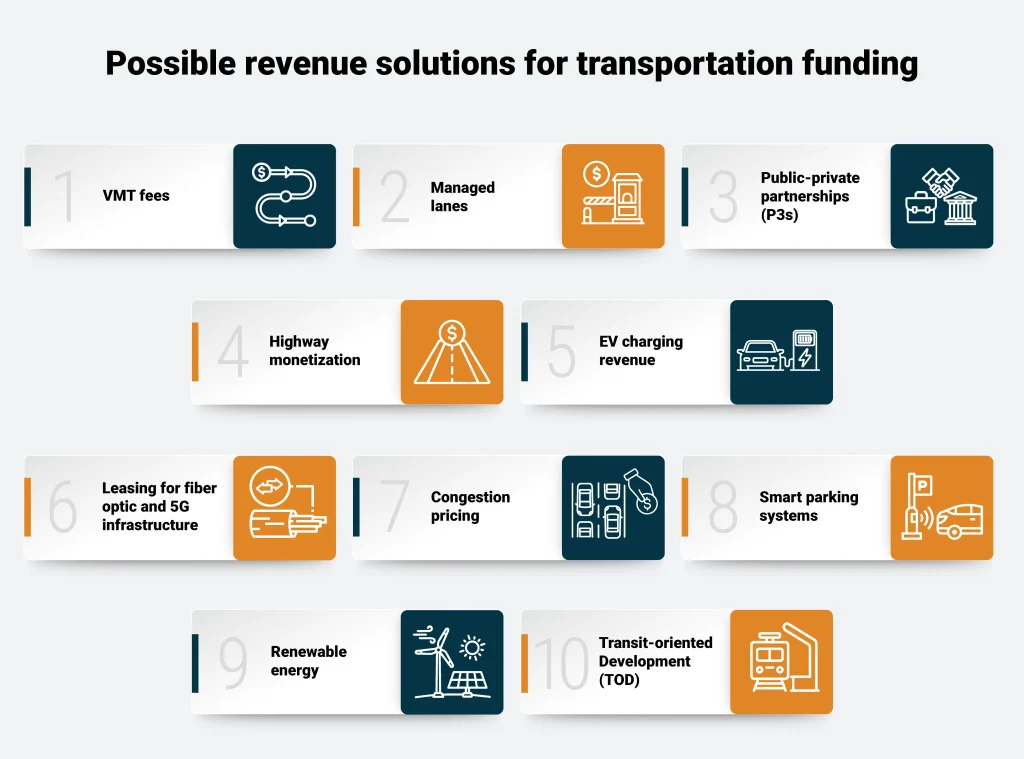
- Leasing for fiber optic and 5G infrastructure: Lease space along transportation corridors to telecom companies to create steady revenue. Louisiana allows private providers to install fiber optic infrastructure along highways, supporting the state’s Intelligent Transportation Systems (ITS) while generating revenue.
- Congestion pricing: Charge peak-time road users to reduce traffic and reinvest in transit systems. New York City became the first city in the United States to implement congestion pricing, charging vehicles entering Manhattan’s central business district.
- Smart parking systems: Adjust parking fees based on demand to optimize parking efficiency and generate additional revenue. San Francisco’s SFPark uses sensors to monitor parking and adjust rates based on demand, raising prices at peak times and lowering them during off-peak times.
- Renewable energy: Install solar panels or wind turbines along highways to generate stable revenue and reduce operational costs over time. In 2008, Oregon became the first state to install highway solar panels along the I-5 corridor. This initiative has attracted private investment and lowered Oregon’s energy expenses.
- Transit-oriented Development (TOD): Develop residential and commercial spaces around transit hubs to boost ridership and capture additional funds due to increased property value. Boston’s Davis Square was revitalized after the MBTA Red Line extension, blending residential and commercial spaces to enhance walkability and transit access.
Empowering regions to build sustainable transit
While innovative funding mechanisms hold promise, their success depends on empowering regions to implement them effectively. Local initiatives like Measure M in California demonstrate the power of regional action, using sales tax revenue for long-term transit and infrastructure improvements. Similarly, congestion-pricing programs reinvest revenues into local transit systems, creating a cycle of continuous investment and improvement.
Regions need legislative flexibility, operational autonomy, and interstate collaboration to maximize impact. Such initiatives allow local governments to take control of their transportation future while advancing broader economic and sustainability goals.As the transportation sector evolves, agencies must rethink how they manage infrastructure investments.The increasing complexity of funding mechanisms—ranging from federal grants to tolling and congestion pricing—demands a more sophisticated approach. Digitization is the key to navigating funding complexities, optimizing resources, and building resilient infrastructure.
The role of robust capital program management
Capital program management systems are no longer just an operational necessity but a strategic imperative for ensuring infrastructure investments deliver maximum value.
Optimizing transportation funding requires real-time visibility into capital programs. Modern systems integrate new revenue sources, ensure transparency, and enable dynamic adjustments, helping agencies anticipate risks, control costs, and stay on track.
Aligning funding with economic and environmental goals is equally critical. Modern systems can provide comprehensive oversight and serve as early warning tools, alerting stakeholders to emerging risks so they can intervene before challenges escalate. By automating workflows, agencies can improve program delivery and resource management. With centralized, secure data storage that meets the highest federal security standards, agencies can confidently safeguard critical information.
Looking ahead: The road to smarter infrastructure
The road ahead demands strategic foresight and adaptability. With growing scrutiny on infrastructure spending, transportation leaders must embrace digital transformation. A data-driven, proactive approach to capital program management is key to reducing costs, managing risks, and delivering long-term value.
The choices made today will define the transportation systems of tomorrow. By integrating technology, innovation, and collaboration, we can build infrastructure that is efficient and resilient to future challenges.
About the author
Yassmin Gramian, a transportation leader with expertise in emerging systems, brings a proven track record of managing large budgets and complex infrastructure projects. During her tenure as PennDOT secretary, she oversaw a $10 billion annual budget for the state’s vast transportation network, including highways, bridges, and other assets. Her leadership extends beyond PennDOT, with experience on boards like the Pennsylvania Turnpike and the Intelligent Transportation Society of America. Yasmin’s background also includes consulting engineering experience with Jacobs, HNTB, and WSP. She obtained her bachelor’s and master’s degrees in civil engineering from the University of Michigan and has completed Dartmouth’s executive management program.
You might like

About the author
Yassmin Gramian, a transportation leader with expertise in emerging systems, brings a proven track record of managing large budgets and complex infrastructure projects. During her tenure as PennDOT secretary, she oversaw a $10 billion annual budget for the state’s vast transportation network, including highways, bridges, and other assets. Her leadership extends beyond PennDOT, with experience on boards like the Pennsylvania Turnpike and the Intelligent Transportation Society of America. Yasmin’s background also includes consulting engineering experience with Jacobs, HNTB, and WSP. She obtained her bachelor’s and master’s degrees in civil engineering from the University of Michigan and has completed Dartmouth’s executive management program.