
Guide

Introduction
The long-awaited Infrastructure Investment and Jobs Act (IIJA) will provide much-needed funding to address the deteriorating infrastructure across the United States. In 2021, the American Society of Civil Engineers (ASCE) graded the United States infrastructure a C-, a potentially dire situation for the future of our country’s roadways, waterways, airports, and seaports.
According to the 2021 ASCE Report Card, America’s ports supported more than 30 million jobs and approximately 26% of our nation’s GDP. But the report warns that without updating these ports and waterways, the country could face further supply chain and labor issues. Decades of neglect of the country’s railways, seaports, and airports have left the country in a vulnerable position regarding the movement of goods and supply chain issues.
According to several surveys, none of the top 25 airports are in the United States, and only four of the ports have made it to the global top 50 ports list. Furthermore, the waterways and ports have billions of dollars in backlogged repairs.
On November 15th, 2021, President Joe Biden signed into law House Bill H.R. 3684, otherwise known as the Infrastructure Investment and Jobs Act (IIJA). According to the White House, this bill addresses the immediate need for an updated infrastructure of ports, waterways, and airports to deliver near-term assistance and long-term investments to strengthen America’s supply chain resiliency.
An overview: Infrastructure Investment and Jobs Act
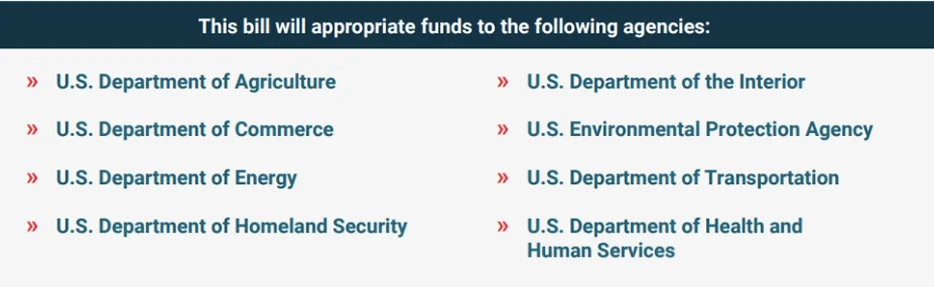
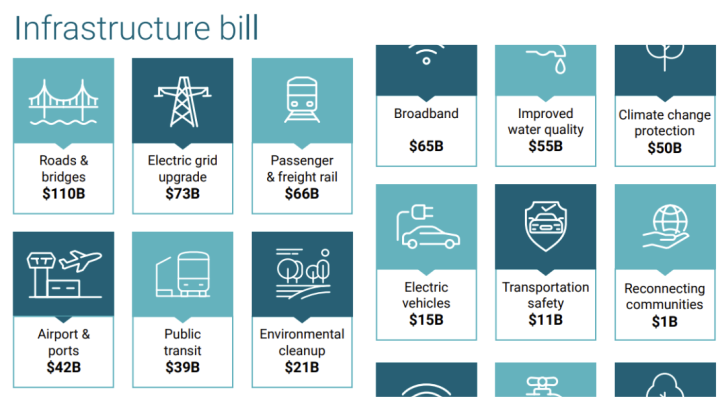
The IIJA will provide $973 billion over the next five years (the fiscal years 2022–2026) to fund a multitude of old and new programs to improve transportation, including railways, seaports, and airports across the country.
With the first portion of funds set to be appropriated at the start of 2022, state agencies are rapidly preparing to launch new projects across the board, from shovel-ready to larger, more complex projects. With a roughly 20% higher budget than in 2021, the additional funds can be used to address many of the errors made in America’s transportation grid in the 1950s. To many, the bill is a path to the future through equity, sustainability, collaboration, and technology. According to the 2022–26 market analysis conducted by the American Road and Transportation Builders Association (ARTBA), port and waterway construction market activity is expected to grow by 6% in 2022. Similarly, Amtrak plans to serve at least 160 new communities by 2035, leading to billions in economic activity and tens of thousands of new jobs.
Highlights: Airports, ports, and rail sectors
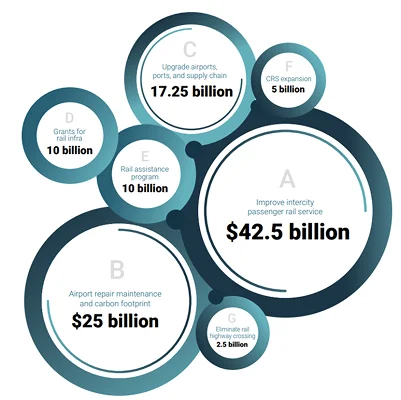
- $42.5 billion will go toward expanding as well as improving intercity passenger rail service.
- $25 billion has been set aside for airports to address repair and maintenance backlogs, reduce congestion and emissions near ports and airports, and drive electrification and other low-carbon technologies.
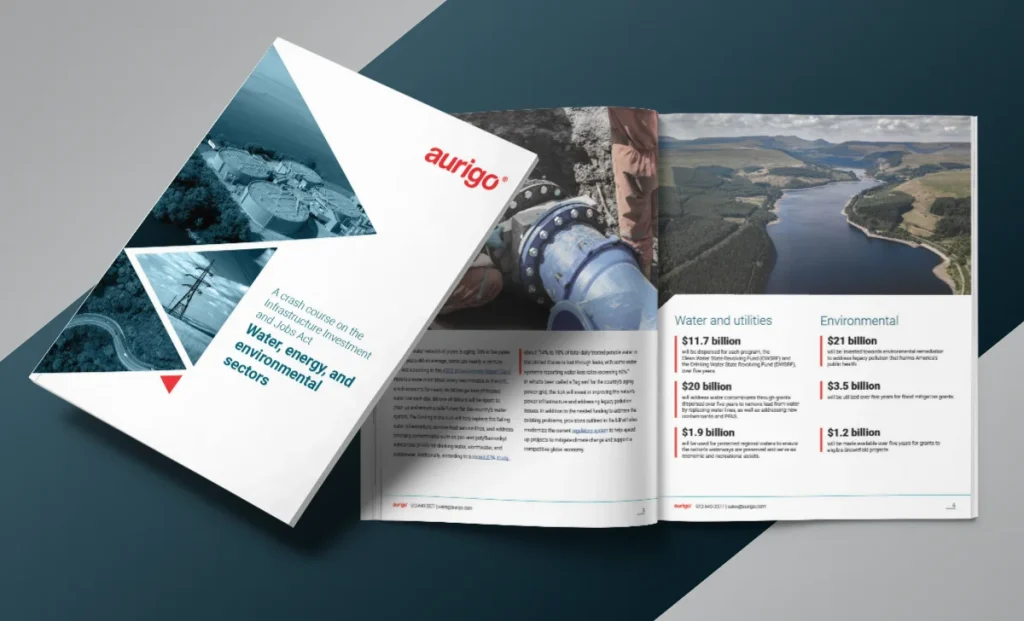
- $17.25 billion, over five years, will go toward upgrading airports and ports to strengthen supply chains and prevent disruptions that have caused inflation.
- The IIJA has established a new $10 billion competitive grant program for rail infrastructure.
- $10 billion will be used in a new rural assistance program for communities with populations under 150,000 to provide technical, financial, and legal assistance.
- The Consolidated Rail Infrastructure and Safety Improvements (CRISI) Grant Program will get an expansion of $5 billion over five years.
- $2.5 billion will be apportioned for a competitive grant program to eliminate at-grade rail-highway crossings to improve the health and safety of communities.
Equity and the IIJA
Significant funding from the IIJA will improve seaports and the country’s rail system. It will also address the backlog of projects, some dating back ten years to the damage done during Hurricane Sandy in 2012. In addition to moving goods, the nation’s railways are an essential mode of transportation for many Americans. Amtrak will receive $66 billion to improve and expand services between cities, making rail transit more accessible to low-income communities and communities of color.
The White House says, “The legislation positions rail to play a central role in our transportation and economic future, investing $66 billion in additional rail funding to eliminate the Amtrak maintenance backlog, modernize the Northeast Corridor, and bring world-class rail service to areas outside the northeast and mid-Atlantic.”
The investment in passenger rail service, the largest since Amtrak was created 50 years ago, will create a safe, efficient, and climate friendly way to move people and goods.
Communities of color are twice as likely to take public transportation, and many of these communities lack good public transit options. Additionally, improving transportation options for millions of Americans will lead to new opportunities, including more affordable housing options. Furthermore, there is a multibillion-dollar repair backlog, representing more than 24,000 buses, 5,000 rail cars, 200 stations, as well as thousands of miles of tracks, signals, and power systems in need of replacement, which can now be addressed with the new funding through the IIJA.
Roughly $600 million per year will also go toward making pedestrian and motor crossings safer for all Americans. The funds will be used to support safety by eliminating or separating places where railroads and motorists interact. In doing so, better freight mobility and reduced motorist wait times can also be achieved.
Projects in eighteen states will receive funding through the Infrastructure for Rebuilding America (INFRA) program to support jobs and local economies.
“These timely investments in our infrastructure will create jobs and support regional economies while helping to spur innovation, confront climate change, and address inequities across the country,” said Secretary Pete Buttigieg.
Sustainability and the IIJA
The IIJA will help the country take its first few steps toward emissions and pollution goals set for 2030. Before signing the IIJA, President Biden set a 2030 greenhouse gas pollution reduction target, aiming to reduce greenhouse gas emissions by 50% to 52% from 2005 levels by 2030. Furthermore, $18.9 billion is set aside for carbon management infrastructure, with $15 billion earmarked specifically for low-carbon mobility. The success of the investments into ports and waterways relies on the success of the roads, bridges, air, and rail transportation improvements.
While freight railroads are already the most eco-friendly of land and freight transportation (reducing greenhouse gas emissions by 75% compared to trucks), the Department of Energy’s new Office of Clean Energy Demonstrations will oversee $21 billion in projects to improve this area further. These projects include those aimed at reducing emissions in long-distance transportation using freight railroads.
The sustainable transport of goods via waterways is another crucial element of the IIJA. For example, $829.1 million in funding has been awarded this year for the Navigation and Ecosystem Sustainability Program (NESP) to improve the Upper Mississippi River System (UMRS). Specifically, the funding will be used to complete the modernization of Lock & Dam 25, including the construction of a new 1,200-foot lock, an environmental restoration project at Lock & Dam 22, and other small-scale ecosystem and navigation projects in the region. Modernization and repairs to waterways boost the supply chain and improve agricultural and wildlife habitats.
Collaboration and the IIJA
It has never been more critical for collaboration among internal and public stakeholders. In part, disinvested communities came to be because of the lack of communication with the public and the ease of right of way land purchase. The success of the projects over the next several years will rely on two key factors:
Communication with the public
Public engagement should be at the forefront of any project that will impact a community. The American Road & Transportation Builders Association estimates that the money allocated for just the transportation sector will add $488 billion to the U.S. GDP by 2027. With so much on the line for the American citizens, public feedback can help shape projects for the betterment of all.
Collaboration with internal stakeholders
Consistent processes, a single source of the truth, and digitization of processes will ensure that your projects stay on track. As outlined in the next section, the IIJA explicitly sets money aside for technology for this sole purpose.
Interorganizational communication will play a prominent role in successfully launching projects. With so many projects ranging from water to roads being undertaken, builds and digs (e.g., road, water, sewer, gas, electric, etc.) involving the right of way can save both time and money.
IIJA and technology
All eyes are on the construction industry heading into 2022. The American Road & Transportation Builders Association estimates that the combined $153.7 billion in new highway, bridge, and public transit investment money allocated for just the transportation sector will add $488 billion to the U.S. GDP by 2027. Investing in technology, security, and a skilled workforce ahead of the flurry of projects will set your agency up for success. Workforce shortages are at an all-time high, with the Associated General Contractors (ACG) reporting that 89% of contractors are having a hard time finding labor.
This is why the IIJA will also direct $100 million over five years to be used for advanced digital construction management systems and related technologies. These funds will be used to work toward the goal of maximizing interoperability with other systems, products, tools, or applications, thus boosting productivity, reducing project delays and cost overruns, and enhancing safety and quality. McKinsey estimates that if contractors more widely used these technologies, construction productivity would increase by 14% to 15%, while the construction costs would decrease by 4% to 6%. Therefore, $100 million devoted to construction technologies is equally important to project funding to ensure that the money allocated is used timely and accurately.
The IIJA aims to accelerate technology adoption for public agencies specifically with the goal of promoting, implementing, showcasing, supporting, and documenting the application of advanced digital construction management systems, practices, performance, and benefits. Adding the additional funding to new and existing technology systems will help agencies better prioritize, manage, and maintain the funding and onset of projects over the next several years.
This technology will also help contractors increase productivity and transparency. With new regulations regarding project reporting, the government can easily track how funds are being allocated and ensure efficiency. As highlighted in the IIJA, the technology funding should be used to:
- Accelerate state adoption of advanced digital construction management systems applied throughout the construction lifecycle (including through the design and engineering, construction, and operations phases).
- Provide more timely and productive information-sharing among stakeholders through reduced reliance on paper to manage construction processes and deliverables.
- Deploy digital management systems that enable and leverage digital technologies used by contractors on construction sites. These could range from state-of-the-art automated and connected machinery to optimized routing software that allows construction workers to perform tasks faster, safer, more accurately, and with minimal supervision.
- Provide technology training and workforce development to increase the capabilities of project managers and sponsors who work with state and local government units.
- Reduce the environmental footprint of construction projects using advanced digital construction management systems resulting in the elimination of congestion through more efficient projects.
While the construction industry makes up 13% of global GDP, productivity growth has only reached 1% annually, according to McKinsey, due to a lack of technology adoption. Implementing connected construction technology can help the country achieve the ambitious goals (and expectations) set forth by improving coordination and project management.
The IIJA provides a large investment to improve and build upon our nation’s rail, port, and airport infrastructure to help boost the economy. In fact, by streamlining delivery with technology, the industry can save up to $400 billion annually.
There’s a lot on the line for the construction industry as we embark on this massive infusion of funding to the U.S. infrastructure. Embracing technology is more important than ever to help streamline projects and communication as well as prioritize and optimize projects. McKinsey states that “governments must move beyond a project-by-project view and upgrade systems for planning, operating, and delivering infrastructure.”