

Blog
From capital decision to facility delivery: Closing the execution gap in life sciences
Life sciences companies are racing to build manufacturing capacity amid patent expirations, M&A activity, and new tariffs, but disconnected planning, compliance, and execution processes cause costly delays. Aurigo Primus solves this with an AI-native platform connecting capital planning to project delivery, helping facility owners bring capacity online faster and more predictably.


In life sciences, organizations are racing against increasingly compressed timelines. This pressure is anchored by an estimated $300 billion in revenue at risk through 2028 as blockbuster patents expire. Companies are pursuing high-value M&A to replenish pipelines and offset these losses, with deal values reaching $372 billion in 2025. Yet every acquisition starts a countdown on a finite patent window, placing enormous pressure on organizations to bring new manufacturing and R&D capacity online quickly.
This urgency has intensified with new 2026 trade policies that impose a 100% tariff on branded therapies manufactured outside the United States. In response, global pharmaceutical leaders have committed more than $475 billion to domestic manufacturing and R&D capital programs. As portfolios expand and project volumes increase, organizations are facing growing challenges coordinating planning, compliance, and delivery activities across complex capital programs. Delays at any stage can slow facility readiness, postpone product launches, and reduce the value organizations expect to realize from both acquisitions and capital investments.
Utilities have never been better positioned to make bold, long-term capital investments. Yet critical projects still face delays, cost overruns, and shifting priorities. Funding approved at the portfolio level often fragments across budget cycles, creating a disconnect between what leadership authorizes and what teams ultimately deliver. Closing that gap is essential to delivering capital programs with greater predictability and confidence.
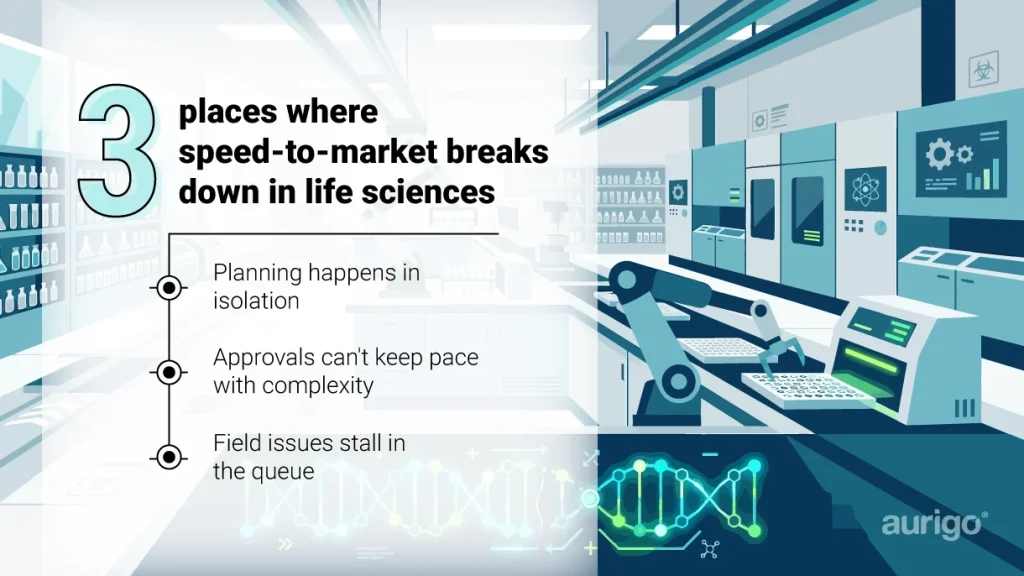
Where speed-to-market breaks down today
Disconnected pipeline and capital planning
n most life sciences organizations, R&D, clinical development, and manufacturing investments are planned in separate teams, on separate timelines, with separate priorities. Facility requirements are rarely tied to pipeline milestones. When pipeline uncertainty shifts priorities, capital is often committed before clinical outcomes are clear, locking organizations into investments that no longer reflect reality.
The consequences compound quickly. Compliance considerations emerge after decisions are already locked in. Regulatory requirements should be incorporated into facility design early, instead of leading to costly redesigns, revalidation cycles, and schedule overruns. Upstream decisions made in R&D or finance do not translate cleanly into what GMP (Good Manufacturing Practice) execution teams need on the ground. That handoff is where time disappears, and facility delays begin to push back drug launches and revenue.
Decision latency in complex, regulated programs
ven when capital is allocated correctly, the approval infrastructure adds its own delays. Multisite, multiyear programs involve layered governance, regulatory oversight across jurisdictions, and coordination between clinical, engineering, finance, and compliance teams. Each approval layer adds time. Each stakeholder handoff carries the risk of information loss.
GMP and validation requirements add another layer. Changes to facility scope, materials, or sequencing require formal documentation, review, and often resubmission. That discipline is necessary, but when governance structures cannot keep pace with program complexity, the burden compounds. A critical issue identified on-site may take days or weeks to reach the right decision-maker and longer still to produce a response that flows back into execution.

Execution friction in highly regulated build cycles
The same problem plays out differently on the build site, where the cost of slow decisions becomes immediate and physical. In GMP environments, a single unresolved RFI (Request for Information) can halt work on a cleanroom or HVAC system for days because no work can proceed without documented approval. Change orders require formal review chains. Field issues that should be resolved in hours sit in inboxes waiting for the right sign-off.
The pain here is operational friction. Construction programs stall when critical decisions fail to move, leaving contractors in limbo while commissioning milestones slip. Because build-stage data, such as submittals, punchlists, and RFI logs, reside in a silo, upstream planners remain unaware of the impact until it manifests as a significant schedule overrun.
One platform, from capital decision to facility delivery
Speed-to-market depends on how effectively organizations align pipeline strategy, compliance governance, and capital execution. When these functions operate as a connected system, teams can make faster decisions, reduce delays, and bring new capacity online more predictably.
Aurigo Primus is an AI-native platform built for facility owners to align planning and execution across the capital life cycle, ensuring strategic priorities translate into real-world outcomes. By connecting upstream planning decisions with project delivery, Primus helps organizations realize the intended value of their capital programs, whether that means accelerating facility readiness, supporting product launches, expanding manufacturing capacity, or meeting compliance objectives.
With AI built directly into workflows, Primus assists users, anticipates risks, and accelerates decisions so teams can move faster while maintaining control. For facility owners across pharma, biotech, Contract Development and Manufacturing Organizations(CDMOs), vaccine manufacturers, and other life sciences organizations managing complex capital programs, Primus brings together two core components, Plan and Build, creating a continuous flow from portfolio planning through project execution so decisions made early in the process remain aligned with delivery outcomes.
Primus Plan eliminates the disconnect between pipeline priorities and capital decisions. As a portfolio planning platform, it gives teams a centralized view of all capital investments across R&D and commercial expansion programs. AI scenario modeling enables teams to prioritize capital aligned to pipeline-stage and funding constraints, evaluating investments by ROI, risk, and pipeline impact. Financial modeling supports multiyear budgets and cash-flow forecasts across R&D and scale-up programs. Portfolio governance keeps decision-making structured and auditable as priorities evolve.
Primus Build removes the approval delays and execution friction that stall programs at the build stage. Rather than critical decisions queuing up in disconnected systems, real-time project insights, strategic foresight, and financial control are available across every active program. Contract management, budget and schedule control, RFIs, punchlists, and submittals are all managed within a single system, so field issues are resolved in hours rather than weeks. Stakeholder collaboration is built in, so critical issues surface faster, and decisions move without delay. As a project execution platform that integrates with leading PMIS systems, Primus Build fits into existing workflows rather than displacing them.
Together, Plan and Build keep capital aligned to clinical and commercial milestones. Real-time data from the build site flows directly back into the portfolio plan, ensuring facilities come online exactly when the pipeline needs them. The old patchwork of spreadsheets and disconnected tools is no longer adequate for the complexity of life sciences programs now demanded. Facility owners who connect capital planning to execution turn a structural liability into a competitive advantage.
See Aurigo Primus in action. Schedule a demo today.→
You might like


Frequently asked questions
Why do life sciences capital projects experience delays between planning and execution?
Many delays originate from disconnected processes across R&D, manufacturing, finance, compliance, and project delivery teams. Capital decisions are often made independently of pipeline milestones, while regulatory requirements and facility design considerations may be addressed later in the process. As projects move into execution, approvals, RFIs, change orders, and validation requirements create additional friction, slowing facility delivery and impacting speed-to-market.
How can life sciences organizations align capital planning with pipeline priorities?
Organizations can improve alignment by connecting portfolio planning, financial forecasting, governance, and project execution within a single system. This allows teams to evaluate capital investments against pipeline maturity, funding constraints, risk, and operational priorities. When planning decisions remain connected to project delivery data, organizations can adapt more effectively as clinical, commercial, or regulatory conditions change.
How does an AI-native platform help life sciences facility owners accelerate project delivery?
An AI-native platform helps teams identify risks earlier, automate routine workflows, improve visibility across programs, and accelerate decision-making. By bringing together portfolio planning, project controls, contract management, RFIs, submittals, budgets, and schedules, organizations can reduce approval delays, improve collaboration, and keep projects aligned with business and manufacturing objectives throughout the capital life cycle.