

Blog
Can utilities bridge the gap between planning and reality?
Utility capital programs most often fail at the handoff between planning and execution, where funding assumptions erode across rate cycles, and reactive repairs drain strategic budgets. AI-native capital planning platforms close this gap by integrating risk-based prioritization, regulatory traceability, and project delivery into a single continuous workflow.


U.S. power providers are entering an infrastructure investment supercycle unlike anything seen in generations. Investor-owned utilities are expected to invest an estimated $1.4 trillion through 2030 as aging infrastructure, manufacturing reshoring, transportation electrification, and AI-driven energy demand reshape the grid. As electricity demand continues to rise, utilities must expand capacity, modernize existing infrastructure, and deliver increasingly complex capital programs.
Utilities have never been better positioned to make bold, long-term capital investments. Yet critical projects still face delays, cost overruns, and shifting priorities. Funding approved at the portfolio level often fragments across budget cycles, creating a disconnect between what leadership authorizes and what teams ultimately deliver. Closing that gap is essential to delivering capital programs with greater predictability and confidence.
Why utility capital decisions fail between planning and execution
Decisions are reactive and not grounded in data
Reactive repairs on aging assets consume budgets intended for strategic investment. Internal influence and subjective priorities routinely override condition data, meaning the loudest voice rather than the highest-risk asset wins the capital allocation. When assets fail, the resulting outages, liability exposure, and regulatory penalties typically far exceed what proactive replacement would have cost. Without quantifying those consequences in advance, there is no analytical basis for defending investment timing decisions internally or before regulators.
Plans break down between approval and execution
Capital programs are built for a specific regulatory and budgetary environment. When that environment shifts across rate cases, budget cycles, or policy changes, plans designed for one set of conditions enter a world that has moved on. The problem deepens at the handoff between planning and execution. Without a common information architecture connecting the two, funding assumptions erode in ways that go undetected until the gap between what was approved and what is being delivered has already widened.
Siloed asset decisions obscure portfolio-level risk
When investment decisions are made asset by asset without visibility across the full system, outcomes are locally rational but collectively suboptimal. A replacement project that clears its own investment threshold may still represent a poor portfolio-level choice when weighed against competing priorities across the grid. Without a system-wide view, capital allocation cannot be optimized, and the highest-impact investments are not always the ones getting funded.

The move to execution-ready portfolios
Execution-ready portfolios transform capital planning from a periodic event into a continuous, auditable governance model.
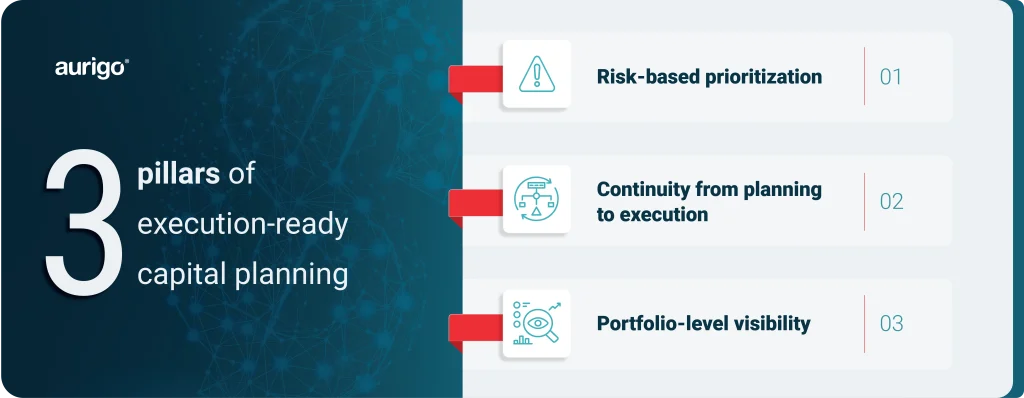
Risk and impact-based prioritization with visible trade-offs
Defensible capital decision-making for utilities starts with a framework grounded in asset condition, failure probability, and consequence modeling across transmission, distribution, and generation assets. Making those risks visible to leadership early in the planning cycle shifts the question from whether to invest to what each timing option costs, including the regulatory exposure associated with deferred maintenance of aging grid infrastructure.
Planning continuity across regulatory cycles and into execution
Capital planning processes must be designed to absorb change rather than require a full reset each time a rate case concludes, a state policy shifts, or a federal reliability standard is updated. The reasoning behind investment decisions needs to remain traceable as programs move into execution so that anything disrupting delivery mid-cycle is visible before it creates a compliance or reliability gap.
Portfolio-level decision-making supported by connected infrastructure
A utility’s capital portfolio must balance grid hardening, system modernization, decarbonization mandates, and reliability requirements, all drawing from the same constrained pool. Optimizing that allocation requires a single AI capital planning platform that allows facility owners to view the entire system at once. At this scale, a connected portfolio planning platform is what separates utilities that sustain capital program performance through rate cycle pressures from those that cannot.
Connecting decisions to delivery with Aurigo Primus
Aurigo Primus is an AI-native platform built for facility owners to connect upstream planning decisions with real-world execution. For utilities, that means closing the structural gap between what gets approved in a rate case and what gets delivered in the field. Primus brings together two components: Primus Plan for capital planning and Primus Build for project execution.
Primus Plan provides utility leaders with an analytical foundation to prioritize decisions based on risk and consequences rather than urgency or internal influence. AI scenario planning, ROI modeling, and multiyear forecasting are woven into the planning workflow so leaders can run what-if analyses across 5- to 20-year horizons before committing capital. Real-time integration with ERP, asset, and delivery systems keeps plans aligned as conditions shift, with full traceability on every revision for regulatory scrutiny.
Primus Build addresses where approved plans most commonly unravel: the handoff between planning and field execution. Contract management, budget and schedule control, RFIs, punch lists, submittals, and stakeholder collaboration are all built in, so funding assumptions don’t erode undetected between authorization and delivery. That is how execution-ready utilities connect decisions to delivery and how the next phase of utility transformation gets built.
You might like


Frequently asked questions
Why do utility capital programs fall short of their approved budgets and timelines?
Capital programs are typically designed around a specific regulatory and budgetary environment. When rate cases close, policies shift, or budget cycles reset, plans built for the previous conditions enter a changed world with no mechanism to adapt. The deeper problem is structural: planning and execution systems rarely share a common information architecture, so funding assumptions erode gradually and go undetected until the gap between what was authorized and what is being delivered has already widened significantly. Reactive repairs on aging assets further consume dollars intended for long-term strategic investment, compounding the shortfall.
What does "execution-ready" mean for utility capital portfolios?
An execution-ready portfolio treats capital planning as a continuous, auditable governance process rather than a periodic planning event. Every investment decision is grounded in asset condition data, failure probability, and consequence modeling rather than internal urgency or influence. The reasoning behind each decision remains traceable as programs move from planning into the field, so anything disrupting delivery mid-cycle surfaces before it creates a compliance or reliability gap. The goal is a portfolio that can absorb change across rate cases, policy updates, and federal reliability standards without requiring a full reset each time.
How should utilities approach capital allocation across competing grid priorities?
Grid hardening, system modernization, decarbonization mandates, and reliability requirements all compete for the same constrained pool of capital. Optimizing that allocation requires visibility across the entire system simultaneously, not asset-by-asset decisions that are locally rational but collectively suboptimal. A project that clears its own investment threshold may still be a poor portfolio-level choice when weighed against higher-impact alternatives elsewhere on the grid. The most effective approach combines risk- and consequence-based prioritization with AI scenario modeling across 5- to 20-year horizons, so utility leaders can evaluate trade-offs before committing capital rather than discovering misallocations after the fact.