
Blog
How owner-operators can reduce the volatility tax with scenario planning
In volatile markets, the true cost is delayed and misaligned capital decisions. Scenario planning enables owner-operators to model uncertainty, compare trade-offs, and allocate capital with greater speed, clarity, and discipline across complex portfolios.


Owner-operators managing large capital programs across data centers, advanced manufacturing, utilities, and other infrastructure-intensive industries are navigating an increasingly unstable investment environment. Hyperscalers are committing nearly $200 billion to data center expansion, while manufacturers are accelerating facility investments under programs such as the CHIPS and Science Act. At the same time, inflation, supply chain disruptions, and shifting interest rates are reshaping the economics of long-term capital decisions.
This volatility does not just increase risk; it introduces friction into decision-making. When capital plans cannot adapt quickly, organizations lose financial value through delayed projects, misallocated funding, and missed market windows. This erosion of value is what many private owners experience as the ‘volatility tax’—the cost of making high-stakes decisions using tools that were never designed for dynamic, multiyear uncertainty.
The risk is not limited to internal forecasting errors. Many delays originate upstream, within the broader ecosystem that governs access, approvals, and infrastructure readiness. Utility interconnections, environmental permitting, zoning, and coordination across federal, state, and local agencies can all shift timelines unexpectedly. When even one dependency lags, delivery schedules and associated capital returns move with it. Without scenario planning that accounts for these external variables, capital exposure compounds before mitigation options become clear.
Reducing this volatility tax requires more than better forecasts. It requires scenario planning that allows leaders to test assumptions, compare trade-offs, and understand downstream impacts before committing capital.
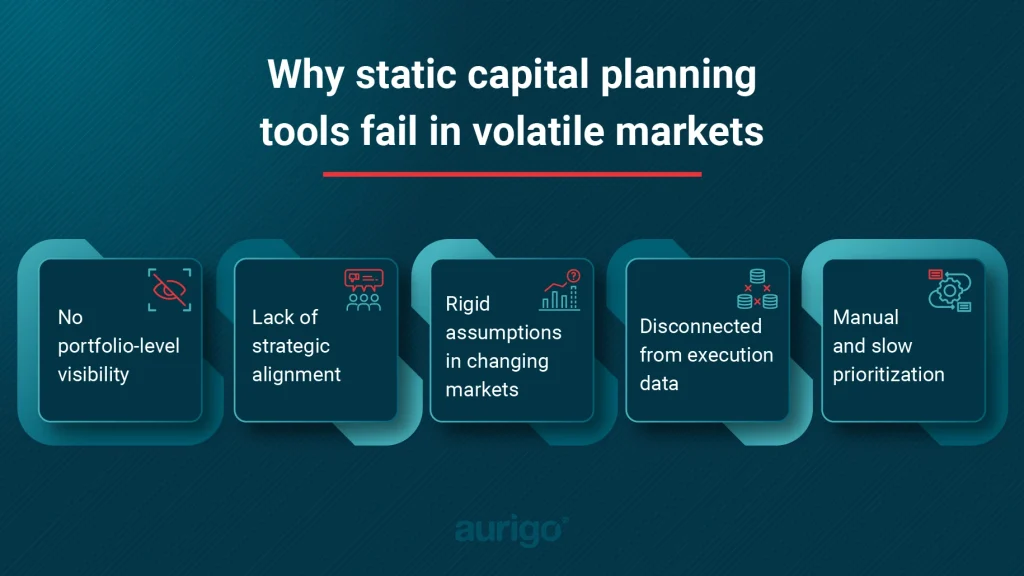
Why static capital planning tools fail in a volatile market
As inflation, supply chain disruptions, and interest rate changes increase uncertainty, disconnected planning tools force you to look backward. Here are the critical limitations of relying on static tools:
1. No portfolio-level visibility
Viewing projects in isolation creates invisible dangers. You suffer from resource cannibalization, in which competing projects unknowingly fight for the same limited resources. You miss dependencies: a delay in one project can silently trigger a chain reaction that blocks another. Finally, a fragmented view masks risk concentration: while individual projects may look safe, your entire portfolio could be dangerously overexposed to a single fragile vendor or supply chain.
2. Financial modeling tools miss strategic alignment
Even advanced ERP modules may fail here because they are designed for retrospective accounting rather than forward-looking planning. ERPs are typically built to track one consolidated budget, making it difficult to model competing scenarios side by side without overwriting data.
While an ERP can confirm whether you have the budget, it cannot analyze whether a project aligns with your five-year growth goals or ESG (Environmental, Social, and Governance) mandates. By treating projects strictly as expense line items, these tools ignore non-financial factors, such as risk scores or operational urgency, forcing you to make decisions based on the lowest price rather than the highest value.
3. Rigid assumptions in volatile markets
Static models cannot keep up with volatile demand. When faced with AI-driven expansions or rate changes, these tools fail to adjust, leaving your plans obsolete. Updating a single assumption triggers a massive manual rework burden, forcing you to audit dozens of linked files. By the time the analysis is ready, the market has moved again. In addition, these tools cannot stress-test against breakpoints, limiting you to an optimistic view that ignores risks such as material spikes.
4. Disconnected from execution data
Planning remains theoretical without real-time data from a project management information system. This disconnect forces you to rely on outdated information rather than live field reality. You typically see only paid invoices, missing the critical commitments already made by construction teams. As a result, costs accumulate silently in the field, leaving you blind to overruns until the money is already gone, and it is too late to mitigate the damage.
5. Manual prioritization slows response
Subjective scoring delays decisions. Without automation, prioritization often relies on influence rather than verifiable ROI or strategic alignment. Teams also struggle to weigh conflicting goals such as balancing returns, carbon mandates, and safety compliance, especially when comparing multiple projects across large portfolios, where manual trade-off analysis becomes slow and error-prone.
Worse, when budgets change, the inability to instantly pivot creates critical delays. You often continue spending capital on low-priority initiatives simply because the administrative effort to reshuffle the plan takes weeks.
Scenario planning as a decision discipline, not a forecasting exercise
Scenario planning addresses these structural limitations by reframing capital planning as a continuous decision process rather than a one-time projection. Instead of asking whether a plan is accurate, leaders can ask more practical questions:
- If market conditions tighten, which projects do we accelerate, phase, or defer—and why?
- Where does capital generate the highest long-term return under constrained funding?
- How does delaying one project affect the performance of the entire portfolio?
Answering these questions consistently requires a system that connects strategy, financial modeling, and execution data into a single decision framework.
How Primus Plan supports scenario-driven capital decisions
Aurigo Primus Plan was built specifically to support upstream capital decisions for facility owners and operators managing complex, multiyear programs. Rather than replacing financial or construction systems, it provides the connective layer that allows teams to evaluate, prioritize, and adapt investments as conditions change.
AI-powered scenario planning across multiyear portfolios
Primus Plan enables owners to build and compare multiple capital scenarios simultaneously, group projects, adjust assumptions, and visualize cash flow impacts across years. This allows leaders to understand trade-offs before funding decisions are locked in and to revisit those decisions as conditions evolve.
Objective prioritization under real constraints
Using a common, business-aligned framework, Primus Plan supports automated project scoring based on financial, strategic, and risk criteria. Teams can test how priorities change under different budget caps, timelines, or policy constraints, reducing reliance on subjective ranking and accelerating decision cycles.
Unified financial visibility and ROI modeling
By consolidating budgets, funding sources, and projected returns, Primus Plan provides a comprehensive view of capital deployment across portfolios. Multiyear analysis helps ensure capital is allocated where it delivers the greatest value, not just where funds happen to be available at a point in time.
Continuous alignment between planning and execution
Primus Plan integrates with Primus Build, Aurigo’s construction project management system, or with existing construction management tools to sync commitments and actuals directly into the planning process. As field conditions change, financial forecasts update accordingly, allowing teams to identify emerging risks early and adjust course before overruns escalate.
Portfolio-level insight, not isolated reporting
By combining scenario modeling, real-time data, and AI-driven analysis, Primus Plan helps organizations monitor portfolio health over time, surfacing variances, concentration risks, and opportunities that would otherwise remain hidden.
Reducing the volatility tax through better decisions
Volatility is unlikely to recede. For owners and operators investing at scale, the differentiator is no longer access to capital, but the ability to allocate it quickly, clearly, and with discipline. Scenario planning provides the foundation for that capability, allowing organizations to test assumptions, compare paths forward, and adapt investments as conditions shift.
By unifying multiyear planning with real-time execution data, platforms such as Primus Plan help turn volatility from a source of financial leakage into a manageable variable, reducing the hidden costs that accumulate when decisions lag behind reality.
You might like
Frequently asked questions
What is the volatility tax in capital planning?
The volatility tax is the hidden financial cost organizations incur when capital plans cannot adapt to changing market conditions. In industries such as data centers and utilities, inflation, supply chain disruptions, permitting delays, and interest rate shifts can quickly alter project economics. When planning tools cannot model these changes dynamically, owners experience delays, misallocated funding, and reduced portfolio returns.
Why do traditional capital planning tools fail in volatile markets?
Traditional tools such as spreadsheets and ERP systems are built for static budgeting and retrospective reporting, not dynamic scenario analysis. They limit portfolio-level visibility, make side-by-side comparisons of investment options difficult, and are often disconnected from real-time execution data. This prevents organizations from quickly stress-testing assumptions, reprioritizing projects, or adjusting capital allocation when conditions change.
How does AI-native scenario planning improve capital allocation?
AI-native capital planning software enables organizations to build and compare multiple investment scenarios across multiyear portfolios. It supports automated project prioritization under funding constraints, integrates real-time field data into forecasts, and provides visibility into portfolio risk and ROI. This allows leaders to test trade-offs, quickly adapt capital plans, and reduce financial exposure in volatile environments. Aurigo Primus is an AI-powered capital project management software that helps owner-operators make data-driven decisions.