
Blog
Capital planning | Steering towards objectivity in project prioritization
Objective capital planning requires moving beyond subjective prioritization toward structured, data-driven decision frameworks. By combining scenario analysis, financial modeling, and portfolio visibility, organizations can allocate capital based on long-term value rather than short-term influence.


Capital projects about to be greenlit or receive substantial funding come under intense public scrutiny. As America prepares for one of our most significant infrastructure upgrades in history, administrators at all levels – local, regional, and state-wide – are pressed to meet the needs of their constituents when it comes to providing transportation, clean water, housing, and others. Everyone hopes many of our current infrastructure deficiencies will be resolved with the upcoming bill, but in reality, not all issues can be tackled at once. Investments need to be prioritized according to their strategic impact. Public agencies need the right tools to support them. Outdated systems, spreadsheets, and manual tools increase the time taken to review and approve capital improvement plans. Disjointed systems increase the chances of miscommunication on which projects should be prioritized and why.
Prioritization and the subjectivity trap
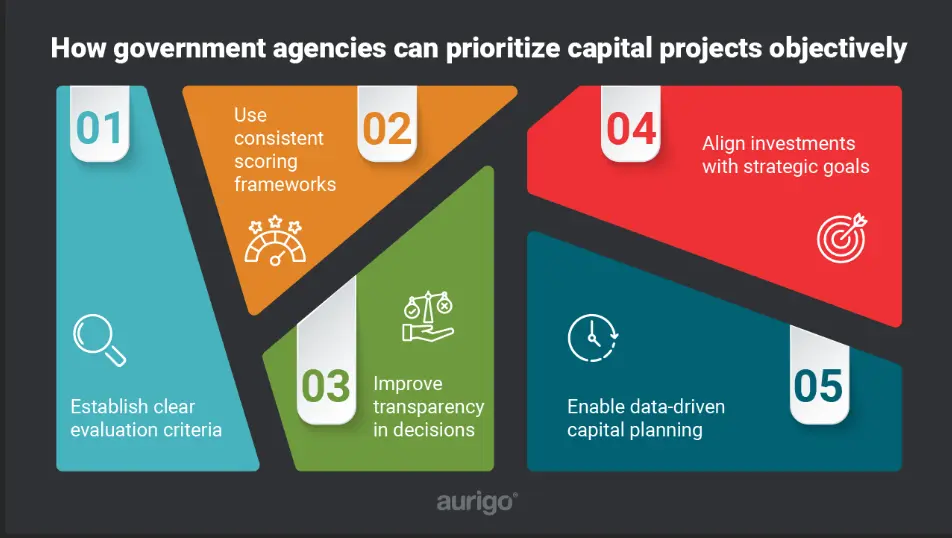
Capital planning isn’t easy. Transportation and other public works departments are expected to create plans that are affordable, inclusive, and efficient. There are also many rules and regulations they need to follow. In addition, decisions often need to be made quickly with limited information on the true complexity, environmental impact, and cost of some projects. There are always multiple stakeholders involved – engineering, finance, elected officials, and the public themselves. That’s why it’s important to have a consistent, repeatable, and transparent way of ranking projects that do not rely on individual opinions.

Maintaining an objective methodology with capital planning tools
Modern capital planning tools can help. A scoring matrix can be created from the agency’s strategic goals. Everyone involved can access the appropriate background information for each project and provide their input electronically. Plans can easily be routed for approval, creating an automatic audit trail. Agencies can tie their projects to specific funding sources, ensuring that money is available to execute projects when needed, which is essential when building a multi-year capital plan. Cash flow needs can then be forecasted. Transparency is achieved through a consistent process that all stakeholders can access. Configurable reports and dashboards allow objective, data-driven decisions to be made. Agencies can use historical data to tell stories of which initiatives were suggested, which were chosen, and why, and how they were carried out.
The path forward
State and local government spending on information technology are in a growth phase. A recent survey showed that mayors and other civic leaders are more committed than ever to embracing innovation and technology. A study by KPMG in 2019 found that capital owners who operationalize forecasting, leverage data, and integrate their systems consistently outperform their peers. There is an immense opportunity for public agencies to build a technology-enabled framework for project prioritization. The American Association of State Highway and Transportation Officials (AASHTO) has called on the Biden administration to include funding for innovation and technology in the upcoming infrastructure bill. It’s time to bring our capital planning into the twenty-first century.
Cloud-based, enterprise-level solutions that harness mobile, AI, and other leading technologies are needed to ensure that we make the most of this historic investment in our transportation, utility, and broadband networks. This adoption of modern tools will help streamline the entire capital planning process and result in infrastructure and facilities that truly meet the needs of the American public. Aurigo Masterworks’ capital planning product puts together everything you need for your capital planning success, from clear strategic priorities, projects, and programs to forecasting, what-if analysis, and the ability to easily communicate and collaborate across all stakeholders.
To learn more about Aurigo Masterworks, click here.
You might like



Frequently asked questions
Why is objectivity critical in capital project prioritization?
Capital allocation decisions shape long-term organizational outcomes, yet many are still influenced by internal bias or fragmented data. Objective prioritization introduces structured evaluation criteria—such as ROI, risk, and strategic alignment—ensuring that investments are selected based on measurable value rather than competing interests.
What challenges prevent organizations from achieving objective prioritization?
The primary barrier is the absence of a unified decision framework. When data is dispersed across systems and evaluation criteria are inconsistent, prioritization becomes subjective. This often leads to misaligned investments, delayed decisions, and reduced portfolio performance, especially across complex, multiyear programs.
How can organizations transition to more objective capital planning?
Organizations can establish objectivity by adopting integrated planning platforms that standardize evaluation models, enable scenario comparison, and provide portfolio-level visibility. When combined with governance discipline, these tools help leaders align capital allocation with strategic goals and respond more effectively to changing conditions.