

Blog
Why federal agencies need capital planning software now more than ever
Federal agencies face growing uncertainty as funding priorities shift, transportation reauthorization remains unsettled, and workforce constraints persist. Discover how Aurigo Masterworks Capital Planning helps agencies prioritize projects, assess funding readiness, model scenarios, and maintain compliance so they can respond faster to changing requirements and funding opportunities.


Federal highway and public transportation programs authorized under the Bipartisan Infrastructure Law (BIL) were scheduled to expire on September 30, 2026. A short-term extension now keeps those programs running through December 11, 2026, giving Congress more time to complete a long-term surface transportation reauthorization.
The extension prevents an immediate lapse, but it does not remove the uncertainty facing agencies responsible for multiyear capital programs. Funding priorities can shift, unobligated balances can be redirected, and projects that are not ready to move can miss narrow funding windows.
Rail shows what this looks like in practice. The FY2026 spending law rescinded $950 million in unobligated rail funding, including $929 million previously directed to California’s high-speed rail program. The example was not tied to BIL funding, but it demonstrates the broader exposure of unobligated federal dollars.
Speed matters, and speed depends on capacity, which is in short supply on both sides of the problem. Deloitte’s 2026 Engineering and Construction Industry Outlook estimates that the construction industry will need 499,000 additional workers in 2026. At the same time, EY’s 2025 Federal Trends Report finds that 56% of federal IT decision makers identify modernization as a priority through 2030.
This is precisely the kind of volatility that capital project and portfolio management is designed to handle. Agencies that invest early in capital planning software are better positioned to act when funding windows open, priorities change, or projects need to be reassessed.
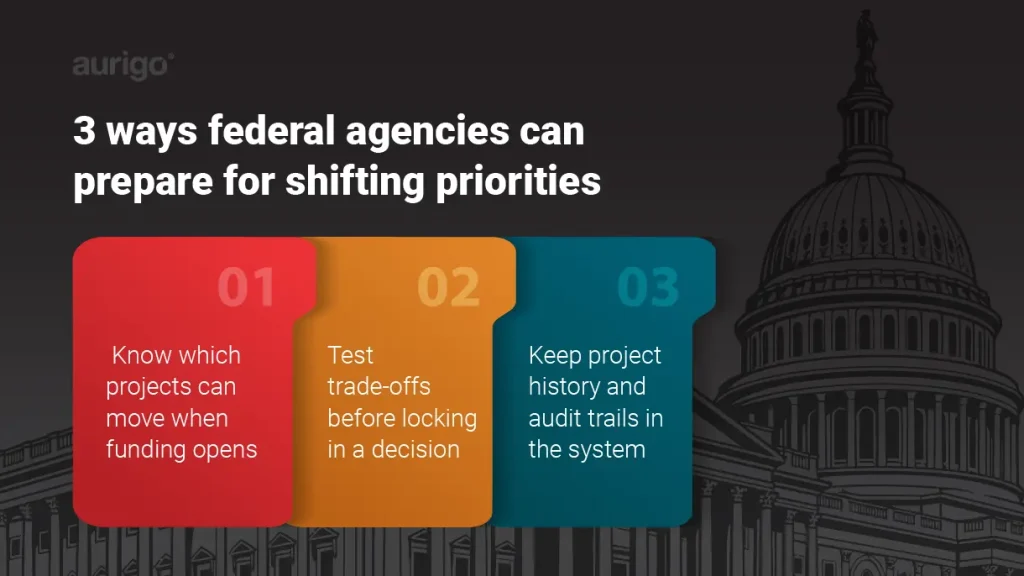
How agencies can prepare for shifting priorities
Capital planning software helps agencies understand which projects can move, evaluate changing conditions, and preserve the information needed to maintain momentum.
See which projects are ready to move
Projects with completed plans, current cost estimates, and required permits are better positioned to move when funding becomes available. Projects with missing documentation or unresolved dependencies need attention before a funding window opens, not after it closes.
When design progress, permitting status, cost estimates, and funding eligibility live in one place instead of across separate tools, teams can assess readiness without losing time to handoffs or manual reconciliation. This connected view also makes it easier to identify gaps across the project pipeline and focus effort where it can have the greatest effect.
The consequences compound quickly. Compliance considerations emerge after decisions are already locked in. Regulatory requirements should be incorporated into facility design early, instead of leading to costly redesigns, revalidation cycles, and schedule overruns. Upstream decisions made in R&D or finance do not translate cleanly into what GMP (Good Manufacturing Practice) execution teams need on the ground. That handoff is where time disappears, and facility delays begin to push back drug launches and revenue.
Model change before committing
Agencies can compare cost, schedule, funding, and delivery trade-offs before a decision is locked in. Scenario modeling helps teams understand how changes in available funding, timelines, or program priorities could affect the portfolio and which projects should move forward. For paused or canceled projects, maintaining a clear record of current status and restart requirements can help teams resume work without starting over.
Preserve knowledge and strengthen compliance
When project history and decision context live in the system instead of in someone’s head, programs are less likely to stall when experienced staff leave. New team members can access the information behind earlier decisions without reconstructing it from emails and spreadsheets.
Current requirements can also be incorporated into standardized workflows, reducing the burden on individual teams to interpret and apply each change manually. This creates a more consistent record of reviews, approvals, and decisions and helps agencies remain audit-ready as requirements evolve.
The pressures that make these capabilities necessary are not going away. Agencies continue to face evolving federal requirements, faster-moving program priorities, workforce constraints, and persistent delivery challenges. Accenture reports that 92% of infrastructure and capital projects fail to meet expected outcome, schedule, and budget commitments.
Handling this kind of pressure is not a new requirement for agencies. It is simply more constant than it used to be.
Strengthen federal funding readiness with Masterworks Capital Planning
Aurigo Masterworks Capital Planning helps federal agencies maintain a prioritized pipeline of projects that are ready to move when funding becomes available. Teams can evaluate proposed investments using consistent criteria, identify gaps in project readiness, and align projects with current funding requirements and agency priorities.
When appropriations or policy priorities change, agencies can model alternative funding and delivery scenarios before committing resources. This helps decision makers understand which projects can advance or be deferred and how changes could affect the broader capital plan.
Masterworks Capital Planning also maintains project assumptions, evaluation criteria, approvals, and funding decisions in one connected environment. This preserves institutional knowledge and creates an audit-ready record of how projects were evaluated and prioritized, even as staff, leadership, and federal requirements change.
With long-term reauthorization still unsettled, agencies that strengthen their project pipelines and planning processes now will be better prepared to respond as funding opportunities and priorities evolve.
You might like


Frequently asked questions
What is capital planning software?
Capital planning software helps agencies capture infrastructure needs, evaluate and prioritize proposed projects, align investments with available funding, develop multiyear forecasts, and compare planning scenarios. It replaces fragmented spreadsheets with a governed planning environment where decisions, approvals, and revisions remain traceable.
How can capital planning software help federal agencies respond to funding changes?
Capital planning software allows agencies to score and rank projects using consistent criteria, map funding sources to projects, and model what-if scenarios when appropriations or priorities change. This helps teams understand which projects are ready to advance, how funding changes could affect the portfolio, and where plans may need to be adjusted before resources are committed.
How does an AI-native platform help life sciences facility owners accelerate project delivery?
Yes. Aurigo Masterworks is a FedRAMP Class C-certified capital program management platform designed to help federal agencies govern investments, manage complex funding and compliance requirements, and maintain audit-ready controls across multiyear capital programs.