

Blog
Why utility capital plans struggle to keep finance and the field aligned
Utilities face growing pressure to align capital investments with financial constraints, reliability needs, and changing operational priorities. Discover how Aurigo Primus Plan helps finance, engineering, and operations teams prioritize projects, model capital and O&M trade-offs, and make transparent, informed portfolio decisions as conditions change.


Ask a distribution engineer what next year’s capital budget looks like. Then, ask finance the same question three months later. You may get two different answers.
That gap is expensive. Deloitte’s 2026 Power and Utilities Industry Outlook puts U.S. electric power sector capital needs at more than $1.4 trillion through 2030. A ScottMadden review of the largest U.S. electric utilities identifies more than $1.2 trillion in planned capital investment over the next five years.
The money may be committed, but the plan approved at the start of the year rarely remains untouched. Weather, storm costs, shifting revenue, regulatory requirements, equipment lead times, and changing project conditions force utilities to revisit spending throughout the year.
The challenge is keeping the numbers current while weighing which projects should advance, which can wait, and how each choice affects reliability, affordability, operating expenses, and the broader portfolio.
Why utility capital plans fall out of alignment
Finance and the field start from different constraints
Line organizations build capital requests from the bottom up. Asset condition, load growth, reliability, safety, and regulatory requirements shape what engineers and operations teams believe needs to be funded. Their view is detailed, local, and grounded in the work required to keep the system operating.
Finance starts from a different position. Revenue expectations, affordability, credit metrics, corporate allocations, and earnings commitments determine how much the utility can spend across capital and Operations and Maintenance (O&M). These constraints apply across generation, transmission, distribution, and other business units, each of which may have developed its plan independently.
When those plans are consolidated, the total often exceeds the available budget. Projects must be resized, deferred, or moved between periods. Yet, the reasoning behind those changes does not always return to the teams that submitted them.
To the field, the decision-making process can be hard to follow. A project viewed as operationally important may be delayed without a clear explanation of the portfolio-level trade-off behind the decision.
Broad percentage cuts make this harder. Reducing every department by the same amount may balance the budget, but it does not establish whether a deferred transmission project carries greater reliability or regulatory value than a generation or distribution project that remains funded. Without common evaluation criteria, influence and urgency can carry more weight than comparable evidence.
Many utilities review spending, revenue, and project status frequently, sometimes monthly. ERP and work-management systems may also provide reasonably current information from finance and the field. The harder problem is turning those updates into timely portfolio decisions.
A major storm can introduce unplanned costs. A mild season can reduce expected revenue. A delayed transformer can move a project into the next quarter or year. Finance must determine which projects could be accelerated, deferred, reduced, or removed while field teams assess the operational consequences.
Deferring a project may preserve the current-year financial plan, but it can also affect reliability, regulatory commitments, equipment reservations, and future costs. Accelerating work may appear financially attractive, but permits, labor, engineering resources, or long-lead equipment may not be available.
Utilities may keep their data current and still struggle to evaluate these trade-offs quickly. The challenge is often not a lack of information, but the absence of a transparent way to compare portfolio options and explain why plans change.
Capital and O&M cannot be planned separately
Moving or delaying a capital project can change overhead allocations, increase maintenance requirements, or shift costs into the operating budget. A decision that appears to reduce capital spending may therefore create O&M pressure elsewhere.
The opposite can also occur. Accelerating a capital replacement may reduce future maintenance needs but increase near-term demands on labor, procurement, and cash flow. Viewing capital and O&M together helps utilities distinguish between genuine savings and costs that have simply moved from one budget, department, or year to another.
Handling this kind of pressure is not a new requirement for agencies. It is simply more constant than it used to be.
What connected capital portfolio management requires
Closing the gap between finance and the field does not mean freezing the annual plan. It means giving both groups a governed way to evaluate and adjust it as financial and operating conditions change.
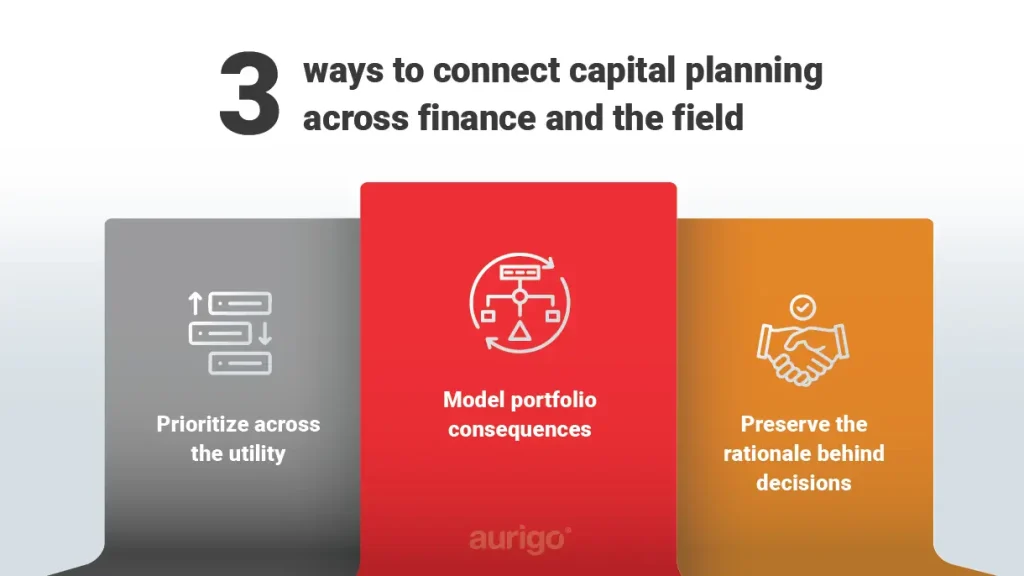
Prioritize across the utility
Utilities need consistent criteria for comparing projects across generation, transmission, distribution, and other business units. Reliability, safety, regulatory obligations, asset condition, financial value, customer impact, readiness, and the consequences of delay should be considered together. The importance of each factor may vary, but the basis for comparison should be visible across the utility.
A common prioritization framework helps leaders understand why one project should advance while another is deferred. It also gives field teams a clearer view of how their requests fit within the utility’s wider financial and operational obligations.
Model portfolio consequences
Scenario planning should show more than which budget line changes. It should reveal how a decision affects capital and O&M, project timing, reliability exposure, available resources, and the multiyear plan.
Leaders should be able to examine questions such as:
- Which projects could be deferred with the least portfolio impact?
- What capital and O&M effects would result from delaying a replacement?
- How would a change affect future-year spending and commitments?
This is particularly important under multiyear rate plans. Moving a project from one year to another may address a near-term revenue or cost variance while creating a larger constraint in a later period. Comparing these effects before changing the plan allows finance and operations to make a more defensible decision together.
Preserve the rationale behind decisions
Every material portfolio change should retain its assumptions, approvals, and rationale. Field teams need to understand why a project was deferred, resized, or removed, while finance needs a record of how financial and allocation constraints shaped the decision.
A traceable decision history makes it easier to revisit choices when assumptions change and provides stronger support for governance and regulatory review. It also helps the utility explain how competing needs were evaluated and why the final allocation was selected.
How Aurigo Primus Plan supports capital decisions
Aurigo Primus Plan supports project prioritization, multiyear budgeting and forecasting, scenario analysis, and portfolio-level capital allocation. Finance, engineering, and operations teams can use common criteria to compare proposed investments, model the effects of accelerating or deferring projects across capital and O&M, and preserve the assumptions and approvals behind funding decisions. This helps utilities adjust their portfolios as conditions change while maintaining a transparent basis for balancing financial constraints with reliability, safety, regulatory, and customer priorities.
You might like


Frequently asked questions
Why do utility capital plans change during the year?
Utility capital plans change as revenue, weather, storm costs, regulatory requirements, equipment availability, and project conditions evolve. Utilities may need to accelerate, defer, resize, or remove projects to maintain financial targets while protecting reliability and safety. Because these changes can affect capital spending, O&M, resource commitments, and future-year plans, they should be evaluated at the portfolio level rather than as isolated budget adjustments.
Why should utilities plan capital and O&M together?
Capital and O&M decisions are closely connected. Moving or delaying a capital project can change overhead allocations, shift work into operating budgets, and affect future maintenance needs. Planning them together helps utilities understand the full financial and operational effect of a decision instead of improving one budget while creating pressure in another.
How can capital planning software improve alignment between finance and the field?
Capital planning software gives finance, engineering, and operations a common framework for prioritizing projects, comparing scenarios, and documenting funding decisions. It helps teams evaluate trade-offs using consistent criteria, understand the effects on capital and O&M, and maintain a traceable record for forecasting, governance, and regulatory review.