

Leadership insight
Drones: Piloting radical innovation in the construction industry
Drones are transforming construction by enabling faster inspections, reducing costs and safety risks, and unlocking new levels of data-driven monitoring and innovation across projects.


Drones can be mesmerizing—in terms of technology, what they can achieve, and the outcomes they deliver. For the construction industry, they spell a new era of dramatic change with their potential to improve process outcomes, bring down operational costs, and reduce occupational hazards.
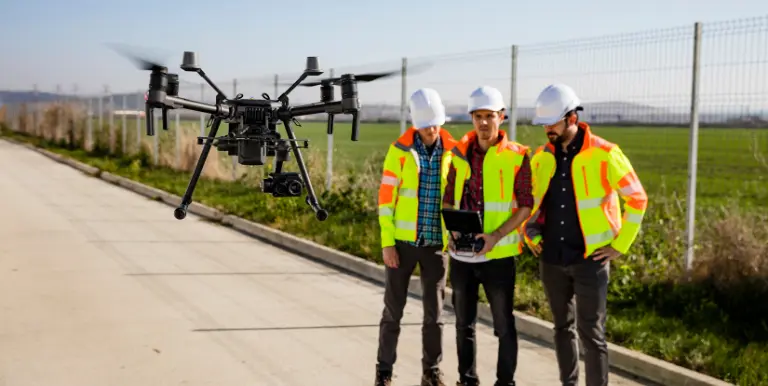
From retailers to airlines and government agencies to logistics operations, every industry is attempting to change the future using drones. EasyJet, American Airlines, and Air New Zealand have begun inspecting aircraft for damage using drones. These airlines don’t spend time and money constructing elaborate platforms around the aircraft for engineers to carry out inspections. Instead, they fly a drone around their aircraft, reducing time and investments by several magnitudes, ensuring their aircrafts stay longer in the sky than in maintenance hangars. Major players such as FedEx, DHL, UPS, and more have tested autonomous drone cargo deliveries to keep abreast with the changing technology. There is a drone explosion coming—and the good news is that there are, at the very least, 321 startups across the United States, United Kingdom, Netherlands, India, Denmark, Spain, Italy, and Israel developing drones specifically for the construction industry.
Getting ready to induct drones
While drones hold enormous promise, on-the-ground implementations in the construction industry haven’t taken off. But the sluggish response to drone technology is about to change. As per a research report, the global drone market is worth an estimated US$30.6 billion and is forecasted to grow annually by 7.8% until 2030. So, expect more drones to show up for work. They will be doing a vast array of tasks, such as surveys, ortho imagery, volumetric analysis, project monitoring, surveillance, reporting, and inspection.
The construction industry—perpetually hounded by project delays, cost escalations, eroding margins, and avoidable accidents—needs drones. Tasks that are traditionally done manually, such as inspecting high rises, chimneys, bridges, etc., take time, planning, and large budgets. According to the UK’s Drone Safe Register, drones can reduce inspection time and cost by anywhere between 70 to 80%. A simple roof inspection of a 2,400 sq ft house with a traditional manual inspection method (scaffolding or an elevated platform) would cost $1,200. Drones can do the same job for as little as $500 and deliver incomparable human safety. Every construction business can take a leaf out of EasyJet, American Airlines, and Air New Zealand’s drone playbook, re-engineer it, and adapt it to its greater advantage.
The opportunity for innovation
Utilities in the United States are already setting the pace with new landmarks in drone usage. For example, New Jersey American Water, an early adopter of drone technology, completed approximately 200 drone flights in 2017 for visual inspections in 55 locations.
In July 2022, American Water announced a Federal Aviation Administration (FAA) waiver, allowing it to fly drones Beyond Visual Line of Sight (BVLOS). This policy change improves American Water’s ability to respond to threats and emergencies in difficult-to-monitor parts of its infrastructure.
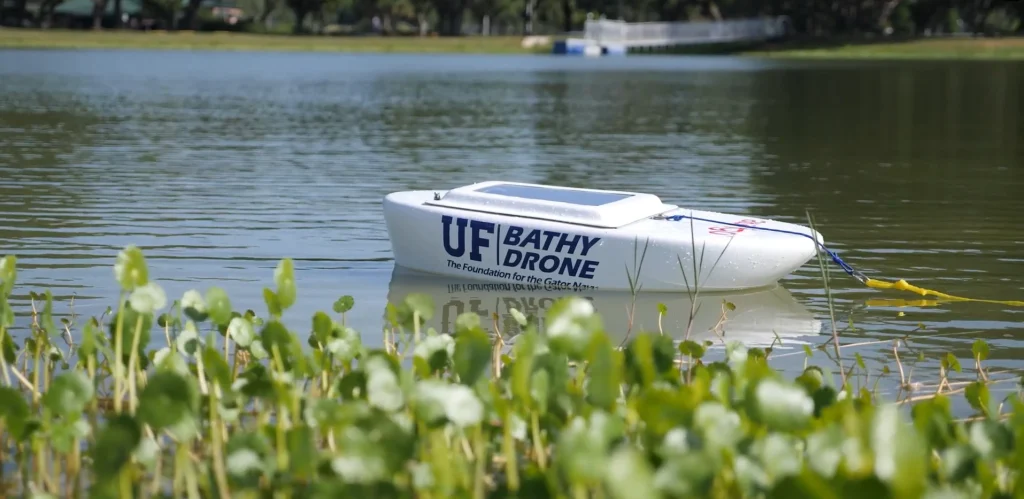
Aurigo has partnered with the University of Florida’s Department of Mechanical and Aerospace Engineering to develop a revolutionary system, provisionally named Bathydrone
The all-new, safer, and more efficient Bathydrone will be used for underwater surveying, mapping, and inspection. The current process to gather data for new underwater construction or the inspection of existing assets such as bridges, docks, and levees consists of manual surveying from divers or survey sensors mounted to a boat. With the new, safer, and more efficient Bathydrone system, a drone drags a small vessel on the water’s surface. The vessel is equipped with a COTS sonar unit mounted on its bottom. The sonar unit, which has down-scan, side-scan, and chirp capabilities, logs data onboard the console located inside the hull. Not only is data collected more easily, but the technology can also be operated remotely and autonomously using AI navigation software.
In Europe and the United Kingdom, wastewater authorities use drones to inspect their underwater pipelines. These drones look for corrosion, damage from material stress, human error, environmental changes, etc. The drones are designed to autonomously navigate narrow spaces, examining about 2,000 feet of pipeline daily. Many of these techniques can be deployed to inspect undersea cables, oil rigs, undersea tunnels, and coral greenhouses, such as those built around Australia’s Great Barrier Reef.
Drone usage presents vast opportunities for innovation. For example, drones can be equipped with sensors that detect an odor in water to identify pollutants and minerals. Similarly, they can be fitted with HyperSpectral imaging systems or thermal sensors to capture important data, such as the identification of construction waste, quickly and efficiently.
Businesses that use drones for inspection can improve the quality of their inspection and additionally use computer vision, artificial intelligence, machine learning, and analytics to identify defects and damage much faster than humans, following it up by recommending remediation processes. Drones can prove especially attractive for projects that involve power lines, wind tunnels, wind turbines, etc., making construction and maintenance several folds more efficient than current levels.
Barriers to adoption and the need to address them
There are two main barriers to the innovation that drones can unleash in the construction and infrastructure industry. First, policies and regulations around drones must be refined and standardized quickly, along with guidance on data usage to protect privacy. The Federal Aviation Administration (FAA) Regulation Act of 2019 has begun this process. Second, there will be a shortage of qualified, certified, and licensed drone operators/pilots, and scaling talent in this area will become critical to success. Drone operators today are busy people and finding and hiring them is difficult.
There are abundant cases of drone usage in the industry. Many of these, such as data collection, will seem trivial in the coming years as drones become more sophisticated. Tomorrow’s drones will have tools to carry out autonomous repair work, such as tightening bolts in inaccessible or dangerous locations or using sealants to repair damaged structures. Very soon, we will be witnessing unprecedented innovation in large infrastructure projects, all thanks to the widespread adoption of drones.
About the author
Shashi oversees the product management teams at Aurigo and evangelizes the future of Aurigo products. He also drives Aurigo’s product strategy, vision, and innovation. Shashi has over 20 years of experience designing and deploying products to various public sector agencies and has been with Aurigo since the company’s inception. He holds a bachelor’s degree in electronics and communications engineering and has completed a post-graduate program from Texas McCombs School of Business, specializing in artificial intelligence and machine learning.
You might like

About the author
Shashi oversees the product management teams at Aurigo and evangelizes the future of Aurigo products. He also drives Aurigo’s product strategy, vision, and innovation. Shashi has over 20 years of experience designing and deploying products to various public sector agencies and has been with Aurigo since the company’s inception. He holds a bachelor’s degree in electronics and communications engineering and has completed a post-graduate program from Texas McCombs School of Business, specializing in artificial intelligence and machine learning.