

Blog
How facility owners can master the capital planning cycle
For facility owners in data centers, life sciences, and manufacturing, fragmented data, subjective prioritization, and inflexible forecasting are compounding capital risk at scale. An AI-native capital planning platform addresses these barriers by linking strategic intent with real-time execution, ensuring every investment decision is defensible and execution-ready before funding is committed.


Capital investment decisions are more consequential and complex than ever. Facility owners in mission-critical sectors are navigating a historic surge in demand: U.S. data center construction starts nearly tripled to $77.7 billion in 2025, driven by the AI infrastructure boom and hyperscaler expansion. Yet this growth is outpacing the industry’s ability to manage costs effectively.
The consequences are measurable. In the life sciences sector, 95% of projects already exceed their authorized budgets. Across capital-intensive industries such as manufacturing, energy and utilities, data centers, and life sciences, fragmented planning tools and reactive decision-making are turning capital programs into sources of financial risk rather than competitive advantage.
This blog explores the most common barriers to capital program performance and how a structured, technology-enabled approach can help facility owners shift from reactive cost management to proactive portfolio discipline.
What are the primary barriers to growth for facility owners?
Fragmented data and governance
When project data lives in disconnected spreadsheets, leadership loses the portfolio-wide visibility needed to make sound capital decisions. This fragmentation does more than create blind spots; it erodes governance at scale. Without a common data environment, compliance records become inconsistent, the audit trail across jurisdictions becomes unreliable, and teams often operate from conflicting versions of the same data.
The result is a governance gap that compounds over time: no standardized oversight, no consistent approval workflows, and no clear accountability when capital decisions go wrong. For facility owners managing multiyear programs, this is not a minor inconvenience but a systemic risk.
Subjective prioritization and planning gaps
Capital allocation often skews toward subjectivity when there is no framework to evaluate projects against ROI tied to business drivers. As a result, budgetary gaps, such as long-lead equipment delays or utility constraints, often go undetected until capital is already committed. Without a shared evaluation checklist, it becomes difficult to determine whether a project supports growth or represents an inefficient use of resources.
Inflexible planning in volatile markets
Multiyear forecasts can become obsolete the moment interest rates or material costs shift. Without the ability to simulate multiple scenarios, teams are unable to quickly reallocate funds when opportunities arise or sites stall. This forces leadership into defensive decisions based on months-old data rather than proactive adjustments.
Inefficient capital sequencing
Misaligned schedules across a portfolio can force internal teams and contractors to compete for the same resources simultaneously. This results in uneven funding demands, with too many projects requiring large capital injections in the same quarter. When funding is released before a site is physically ready, it can lead to costly inefficiencies such as idle crews and equipment storage fees.
Capital waste
Resources sit idle in stalled or low-performing projects when there is no mechanism to identify and reallocate those funds centrally. Allocation errors mean that high-ROI projects are delayed while capital is deployed to suboptimal initiatives. Real-time spending blind spots contribute to budget creep, eroding overall portfolio returns.
Optimize capital programs with AI-native capital planning platform
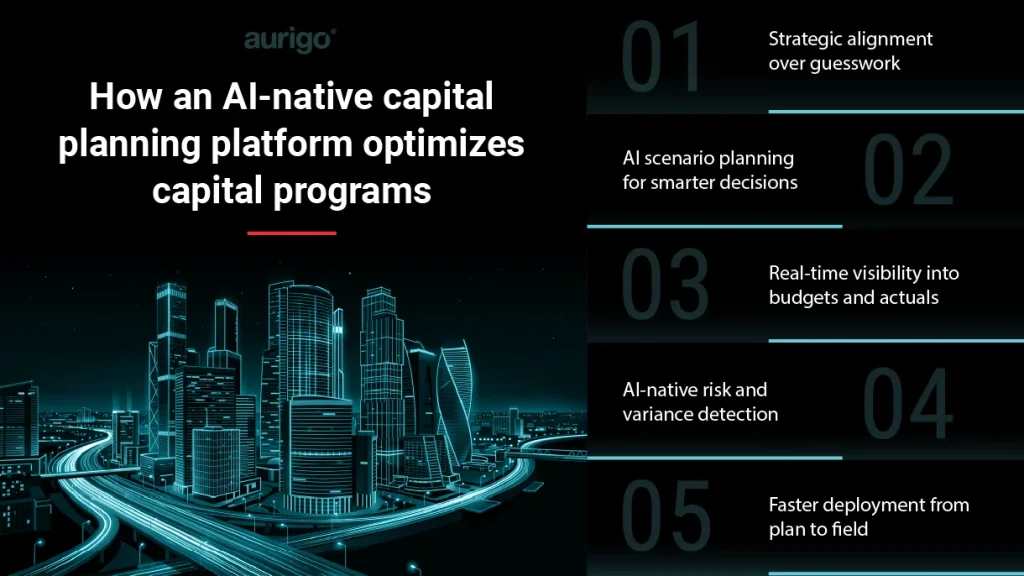
Maximizing a complex portfolio requires aligning every dollar with long-term investment mandates without compromising governance. As an AI-native capital planning platform, Aurigo Primus Plan connects planning, funding decisions, and execution in a single system of action. It brings decisions closer to real-world outcomes by linking strategic intent with real-time field progress, helping ensure programs remain financially sound and transparent.
Prioritize projects with strategic alignment and decision clarity Achieving sustainable budgetary discipline requires a standardized framework for evaluating capital opportunities. Primus Plan establishes this structure through two core pillars:
- Strategic alignment: Fund what matters most
Use a common, business-aligned framework to evaluate and compare capital opportunities. This helps teams prioritize investments and validate early-stage ROI, ensuring funding decisions are anchored to clear business objectives. - Decision clarity: Compare multiple scenarios
Leverage scenario planning to model different investment paths, visualize cash flow impacts, and evaluate trade-offs across multiyear horizons. This enables teams to select the most resilient, high-return path forward with greater confidence.
Deploy funding efficiently and cut needless spending
Maintaining fiscal control across complex programs requires a clear, portfolio-wide view of project finances. Primus Plan replaces static spreadsheets with a single financial view to set budgets, forecast costs, and assess risk in real time. With continuous visibility into budgets versus actuals, teams gain the discipline needed to manage large programs with confidence and avoid misallocation.
Balance risk, return, and funding across your portfolio
By syncing field data directly into the planning process, Primus Plan helps ensure every project stays on budget and follows the corporate investment roadmap. AI-native agents operate within workflows to surface risks, variances, and opportunities early, supporting timely action so teams can respond before issues escalate. This predictive intelligence keeps investments aligned and financially sound even as market conditions change, helping prevent minor field issues from escalating into significant capital waste.
Integrate planning with project execution
Primus Plan connects planning with execution by syncing commitments and actuals from construction, financial, and enterprise systems directly into the planning process. This ensures decisions are informed by real performance data rather than static assumptions. By integrating with leading PMIS tools across the project life cycle, it enables continuous budget tracking, ROI analysis, and full financial transparency from planning through delivery.
Launch new capital programs ahead of competitors
Shorten the time between initial planning and execution to maintain a competitive edge. Primus Plan accelerates this transition by integrating top-down financial planning with real-world execution data, ensuring that authorized funds are deployed into the field without delay. By achieving 95%+ accuracy in ROI and capital expenditure forecasting, it reduces the ‘wait-and-see’ periods common in manual systems, enabling a seamless handover from the corporate office to the project site.
Drive growth with predictive financial oversight
Successfully scaling a capital program amid market volatility requires a fundamental shift toward proactive portfolio coordination. By operating as a system of action with AI continuously supporting decisions within workflows, Primus Plan ensures capital planning remains adaptive, aligned, and execution-ready at all times. By integrating capital objectives with real-time field performance, Primus Plan enables more precise capital deployment, helping ensure investments drive growth rather than create capital inefficiency.
You might like

Frequently asked questions
How does scenario planning improve capital allocation?
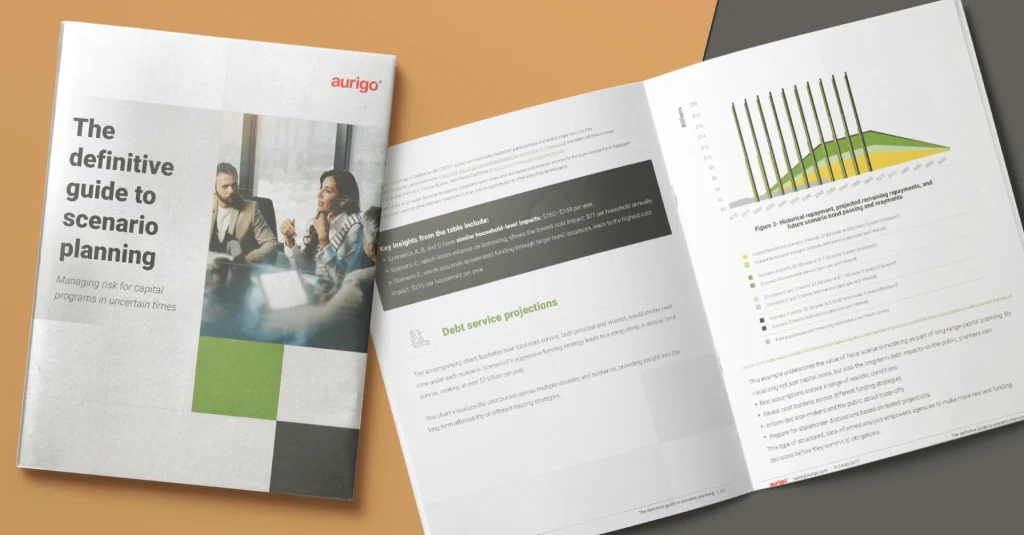
Scenario planning reduces subjectivity by simulating how different investment paths impact cash flow and ROI across multiyear horizons. Instead of relying on ‘gut feel’, leadership can use AI scenario planning to evaluate trade-offs and visualize the long-term consequences of project delays or cost surges. This predictive capability helps ensure capital is prioritized toward the most resilient, high-return initiatives before any funding is committed.
What is the difference between a PMIS and capital planning software?
A PMIS focuses on the ‘how’ of a single project (schedules, RFIs, and field logs), whereas capital planning software manages the ‘why’ and ‘when’ across a global portfolio. Capital planning acts as a strategic layer that integrates with leading PMIS tools to pull real-time actuals into a high-level financial view. This allows owners to track overall portfolio health and forecast cash needs, capabilities that a standard project-level PMIS does not provide.
How can facility owners reduce capital waste in large-scale programs?
Owners can reduce capital waste by replacing reactive reporting with proactive financial oversight. By syncing field performance directly with the corporate office, leadership can identify underutilized funds in stalled projects and quickly reallocate them to higher-priority sites. High-precision expenditure forecasting helps eliminate approval delays that often slow construction, preventing budget creep and idle resources that erode total portfolio returns