
Guide
Modernization of risk and oversight activities
Each year, the Federal Highway Administration (FHWA) provides states with over $40 billion in federal funding for new construction programs to improve the nation’s infrastructure. The funded projects must meet federal requirements and follow FHWA guidance on implementing a project oversight approach. In 2013, the Agency rolled out its risk-based oversight framework, which aimed to maximize the use of its limited resources to improve the successful delivery of projects.
The primary issue with the FHWA risk-based guidance was it lacked a lot of specificity, which allowed each state to determine how to assess and document project risk. Today, not all states fully document their project risk assessments, and the outcomes are fatal (e.g., the collapse of the pedestrian bridge at Florida International University [FIU], which killed six people).
he following white paper aims to align US Department of Transportation Office of Inspector General (DOT OIG) recommendations of the FHWA guidance on risk-based oversight with technology. By drawing lines between the gaps, we will clearly showcase what technology offers to the public sector: insight, transparency, and the ability to improve performance and reduce risk through all construction stages (planning, building, maintaining, and operating).
Assessment of today's infrastructure
As our economy expands, infrastructure spending is not keeping up. The roads and bridges that we drive on every day are crumbling to the point that, the American Society of Civil Engineers (ASCE) has issued the nation’s highways and bridges a “D.” It has been suggested that the nation would need to spend $4.6 trillion over the next decade to address the issues faced by our current infrastructure. The truth is that our roadways are getting deadlier, and the extensive list of long-overdue infrastructure improvements continues to grow.
The AAA Foundation for Traffic Safety reinforces the importance of infrastructure improvements, stating that addressing them could reduce fatalities and crashes by 415,000 over a 20-year period. Granted, human error plays a role in vehicle crashes, but investing in the infrastructure can reduce the number of errors drivers make that lead to life-altering injuries or deaths.
Funding is merely the first step to addressing the issues with our nation’s infrastructure capital improvement programs (CIPs). It has been said that the transportation construction industry ranks low on the list of industries that have properly adopted technology. For instance, the costs allocated to infrastructure by CIPs, which amount to trillions of dollars, are still being tracked and managed with Excel spreadsheets, a multitude of non-integrated software, and pen and paper.
This suggests miscommunication, data entry errors, and a lack of program transparency. The latter begs us to ask such questions as:
- Once the funds are granted to the states, what happens?
- What projects are being funded?
- How are the funds being divided between new projects and maintenance?
- How much is being spent?
- When will the programs be completed?
Keep in mind: This is all taxpayer money.
Federal Highway Administration Guidance
In May 2020, the US DOT OIG issued a report following the March 2018 fatal collapse of a pedestrian bridge at FIU, offering guidance on risk-based project oversight plans.
Unfortunately, this guidance does not clearly define how to effectively create and implement a standard for all infrastructure programs.
The rest of this white paper will help define risks for any CIP and align the recommendations of the US DOT OIG with technology, creating clarity on how to modernize a risk-based program assessment.
Risk-based program assessment meets technology
The FHWA provides over $40 billion in federal funding to states for improvements and new construction on their highways and bridges. As part of its oversight role, the FHWA ensures that funded projects meet federal requirements by following risk-based stewardship, oversight framework, and core principles.
FHWA'S core principles for its risk-based stewardship and oversight framework
- Risk-based: Risk assessment is integrated throughout the performance planning process
- Data-driven: Decisions are grounded in objective data and information to the extent possible
- Value-added: Actions are taken with a primary objective of improving programs and projects
- Consistent: Actions are based on a consistent approach to planning, risk assessment, and stewardship and oversight
Project involvement
- Project actions required by Federal law, such as approving Federal-aid project agreements and obligating Federal funds
- Risk-based project involvement, such as design reviews or field inspections
- Project compliance assessments—reviews of a statistical sample of projects to determine compliance with key Federal requirements
Program involvement
- Program actions required by Federal law, such as approving statewide transportation improvement programs and conducting annual reviews of State DOT financial management systems
- Risk-based program involvement through national and Division initiatives, such as a national review of compliance on State serious injury reporting, or a statewide review of construction safety issues
FHWA'S process for risk-based project involvement

While general guidance and processes are outlined, the FWHA does not clearly define how to assess and document project risk, the criteria by which to evaluate risk, or at what point project risks should be re-evaluated.
To effectively follow the recommendations mapped out by the FHWA, technology must be considered a critical piece that:
- Creates consistency between the disparate departments involved in each phase of the infrastructure program
- Streamlines the process to speed up the time for approvals and eliminate internal bureaucracy
- Delivers transparency, key insights, and status updates for programs and projects, as well as data to help preemptively identity and mitigate risk prior to change orders
To learn how to evaluate, select, and implement the technology that is right for your organization, consider Aurigo’s Roadmap to Selecting a Capital Planning Solution.
Risk-based project oversight meets technology
A digital transformation is difficult for any organization but knowing how modernization will positively impact your CIP and risk-based oversight will make it easier to convince key stakeholders and departments to support the transition.
Risk can be found in any program, and it is important to understand that it may appear at any stage of the construction process, from funding and planning through to construction, maintenance, and operation. A technological solution must operate and allow the transfer of responsibility for managing work across the entire project life cycle—not just one or two areas—as key data points and risk assessments from one area, if not managed properly, can blindside the program manager and could derail the entire program and the funding.
What is a risk?
It is important to establish a baseline and define where risk can be found in any program. Risk comes in many shapes and forms, and can be found in any stage of the CIP.
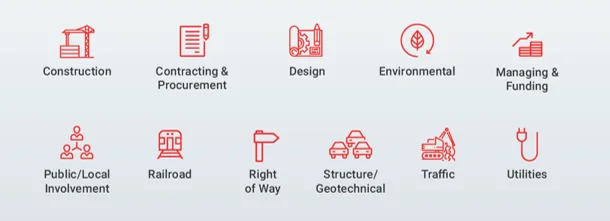
Establishing a team of experts to lead the risk-based assessment for each of these categories is imperative, keeping in mind that, although each risk-based assessment will not take place simultaneously, the information will be needed and will impact each step of the program as it works through the lifecycle.
When working through each risk, the team should clearly identify the risk and the impact it will have on the cost and schedule of the program, leveraging technology to log and track the progress of the risk assessment and make adjustments as the program is affected.
Recommendations
Now that we have identified the different types of risk, we have aligned the US DOT OIG list of recommendations with leading technologies used today to support CIPs throughout their entire life cycle. This means multiple departments—some of which may never interact—will all work and manage the CIP and risk in one system, creating consistency and transparency while streamlining the entire process of building new infrastructure and updating existing infrastructure.
| FHWA recommendations | Technology features |
|---|---|
| Clarify requirements for the project risk-assessment process, including expectations for conducting and documenting risk assessments, and criteria for reevaluating the project risk |
|
| Identify and notify divisions of information that may inform the project risk assessment process, such as the quarterly reports required by grant agreements |
|
| Issue a procedure for conducting and documenting complete project risk assessments |
|
| Clarify the links between elevated risks, associated oversight activities, changes to oversight actions, and the results of risk-based activities |
|
| Develop and implement guidance for documenting risk-based project oversight plans and associated materials, including checklists and standardized forms |
|
| Develop and implement guidance that establishes criteria for the content of risk-based project oversight plans to maintain consistency and avoid creating redundant plans |
|
| Establish procedures for documenting complete risk-based project oversight plans |
|
| Develop and implement a process to routinely monitor implementation and evaluate risk-based project involvement |
|
The shift to modernization from automated process and procedures can be daunting. However, the results, efficiencies, and collaboration that cloud-based solutions offer, centralize communications, standard procedures and processes for identified and non-identified risk, will save time, money, and, in the end, lives.
To learn how Aurigo MasterWorks addresses the US DOT OIG recommendations and further automates the entire lifecycle of capital programs, contact us.
Source: 2017 Infrastructure Report Card https://www.infrastructurereportcard.org/americas-grades/
nfrastructure Spending Could Slash High U.S. Traffic Death Rate https://www.trucks.com/2017/05/25/infrastructure-prevent-high-us-traffic-death-rate/