
Blog
Are U.S. electric utilities future-ready?
U.S. electric utilities face rising demand, aging infrastructure, permitting delays, and workforce gaps; becoming future-ready requires digital transformation, better capital planning, and modern software to improve visibility, resilience, and execution.


America’s electric utilities are at a pivotal moment. Once operating quietly in the background, they’re now at the center of national conversations about digital infrastructure, economic growth, and climate. The explosive growth of electric vehicles and AI-powered data centers is fundamentally changing how and where electricity is used—driving massive new investments that require modern construction program management software to guide decisions.
To meet rising demand and decarbonization goals, the U.S. grid must double in size while cutting emissions by 30%. Meanwhile, data centers alone could account for 9% of total power generation by 2030, further compounding the strain. As America’s homes, industries, and digital economy lean more heavily on electric power, a critical question emerges: Is the grid ready?
In this article, we explore the most pressing challenges utilities face as they work to keep America reliably and resiliently powered.
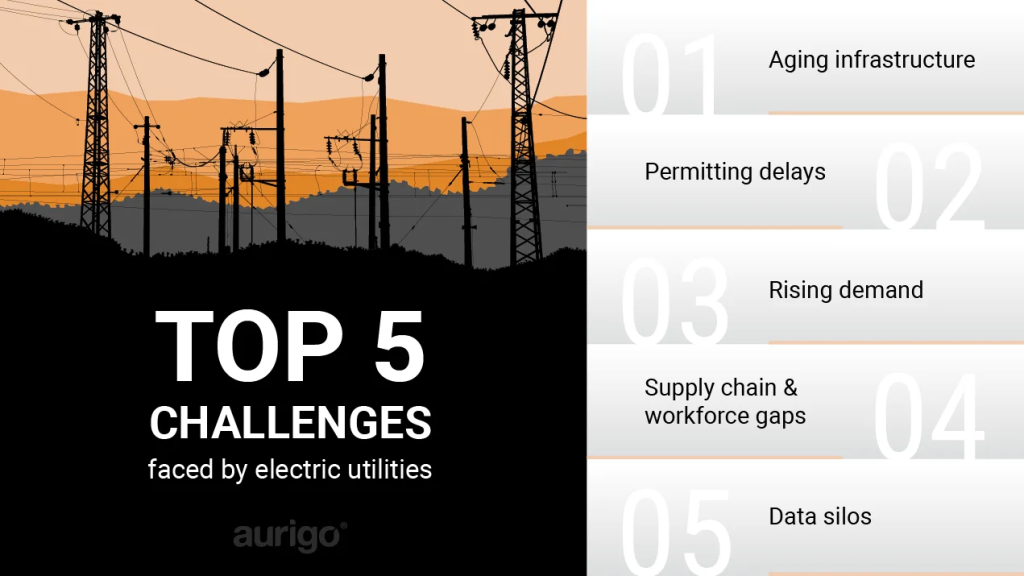
Challenges faced by electric utilities
Outdated infrastructure in a rapidly changing energy economy
Much of America’s power infrastructure dates back decades. As early as 2015, the U.S. Department of Energy (DOE) reported that 70% of transmission lines and transformers were already over 25 years old. Despite today’s far more complex energy demands, many of those same assets are still in use.
These stresses are no longer theoretical—they’re manifesting in costly and dangerous ways. In 2024 alone, the U.S. faced 27 weather and climate disasters exceeding $1 billion in damages, while equipment failures were linked to a surge in wildfires and major outages. Nationally, 80% of large-scale outages since 2000 have been driven by extreme conditions, underscoring the grid’s vulnerability. To address these risks, the U.S. DOE has launched the $2.5 billion Grid Resilience Utility and Industry Grants program to help modernize infrastructure and reduce outage risk.
Permitting hurdles and infrastructure bottlenecks
Infrastructure upgrades often stall due to slow and fragmented permitting processes. Utilities must navigate complex layers of federal, state, and local approvals, often with inconsistent timelines and priorities. These delays inflate costs and slow progress.
Even after project approval, grid interconnection remains a chokepoint. The backlog of queued projects—many ready to deliver power—has surged by 30% in a year. The average wait time has stretched to nearly four years. Disjointed regulatory structures compound the issue, with policies moving at different speeds across jurisdictions. Greater alignment is essential to unlock projects and prevent future gridlock.
Growing demand, limited readiness
Electric vehicles and data centers are driving electricity demand faster than many energy providers can manage. In 2023, the U.S. sold 1.4 million EVs, 9.1% of all new cars, up from just 2.1% in 2018. High-capacity chargers are overloading transformers, causing voltage instability and destabilizing local power flows.
Simultaneously, AI and cloud computing have fueled a boom in data centers, which consume up to 50 times more electricity per square foot than typical commercial buildings. In regions like Texas, this surge has forced agencies to invest heavily just to keep up with baseline demand. Meanwhile, distributed energy resources like rooftop solar and battery storage add new complexity. Though crucial for decarbonization, they reverse power flows and disrupt traditional grid operations—often unpredictably and without consistent standards. The grid was never built for this kind of dynamic, high-volume, two-way demand.
Supply chain and workforce constraints
Getting a project approved is only the first step. From there, agencies face two critical roadblocks: supply chain disruptions and a shrinking skilled workforce. Long lead times for components like transformers, switchgear, and control systems are slowing upgrades and extending outages. At the same time, labor shortages are making it harder to execute initiatives at the pace and scale the energy transition demands.
To keep projects moving despite these challenges, organizations may turn to capital program management software to plan confidently, coordinate suppliers, contractors, and field teams, and maintain control over budgets, schedules, and risk. This need is only intensifying as the industry faces a growing skills gap. As veteran workers retire, agencies are struggling to recruit and train talent equipped to manage modern systems, digital tools, and evolving energy demands. The lack of skilled labor further complicates timelines and strains already stretched teams.
Data overload and operational blind spots
Electric utilities are generating more data than ever, from asset health and maintenance logs to grid performance, weather risk, and capital project timelines. But that information often lives in disconnected systems, outdated spreadsheets, or siloed departments, leading to setbacks and costly missteps. Construction program management software addresses this challenge by streamlining project data across teams and timelines.
Without a unified view of infrastructure needs, investment priorities, and regulatory requirements, agencies struggle to plan effectively or respond quickly. The result is a growing disconnect between available data and actionable insight, leaving blind spots in critical areas like risk forecasting, resource allocation, and long-term grid planning. Better data doesn’t automatically mean better decisions, especially when visibility is fragmented and systems don’t talk to each other.
Modern tools for a modern grid
You might like

Frequently asked questions
Why are U.S. electric utilities under pressure today?
Rising electricity demand, aging infrastructure, and grid modernization needs are straining utilities, making it difficult to maintain reliability while planning for future capacity.
What challenges do utilities face with traditional planning approaches?
Siloed systems, limited visibility, and manual processes make it hard to prioritize investments, forecast demand accurately, and respond to changing regulatory and market conditions.
How can digital solutions help utilities become future-ready?
Modern platforms enable better capital planning, real-time visibility, and scenario modeling, helping utilities improve decision-making, optimize investments, and build a more resilient grid.