


Healthcare is at a crossroads. Spending rose to $4.867 trillion in 2023—18% of GDP, with over 31% directed to hospitals—yet margins fell to just 0.9% by early 2024. Even with recovery projected in 2025 and EBITDA growth of 7% annually through 2028, one truth is clear: it’s not how much we spend, but how we manage healthcare capital that will define the future.
Healthcare has always been a complex undertaking, blending clinical care, compliance, infrastructure, and community needs. That complexity has only deepened as healthcare systems respond to rising patient demand, aging facilities, infection control requirements, and an evolving regulatory landscape—while also managing complex systems such as low-voltage, medical gas, nurse call, and power backup. Leaders must also secure approvals such as Certificates of Need, comply with digital mandates, and operate within constrained budgets.
Despite these pressures, healthcare leaders remain ambitious: 65% are focused on long-term growth over cost-cutting, and 59% are prioritizing AI and digital investments. But with competing demands and finite resources, smarter, future-ready capital planning is no longer optional—it’s a strategic imperative.
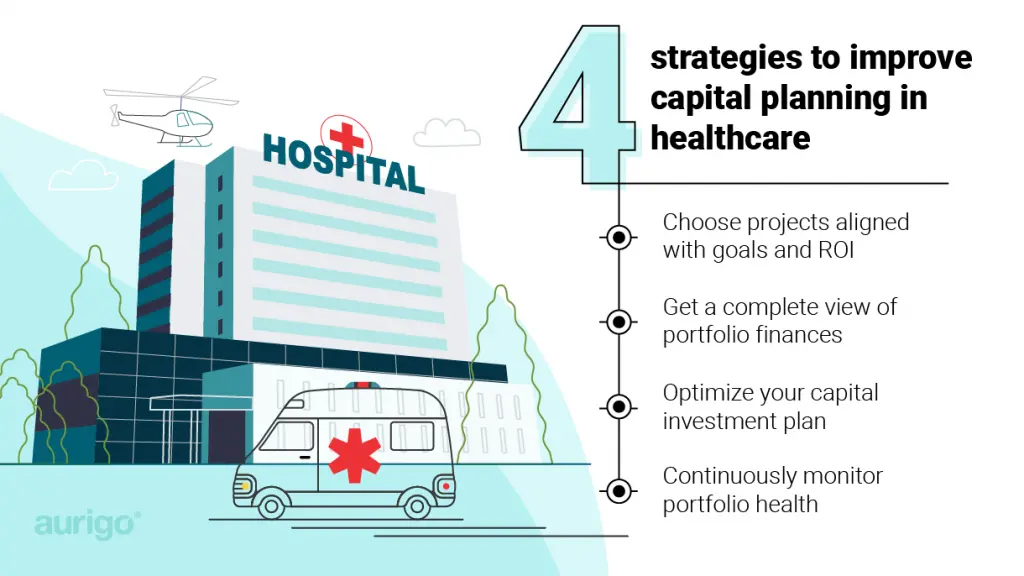
Top 4 ways to strengthen capital planning in healthcare
1. Identify the right opportunities aligned with business goals and ROI
Every investment counts. Healthcare leaders need a standardized way to assess opportunities and approve only those that offer the highest return. Capital planning software enables teams to use a shared framework that aligns with business goals, patient outcomes, and ROI metrics from the earliest stages.
By linking investment decisions to business goals, patient outcomes, regulatory objectives, and real-time activities—from infection control upgrades to major FF&E acquisitions such as MRI machines—healthcare leaders can concentrate on projects that deliver long-term value. If we consider every capital plan a hypothesis about the future, the more context, evidence, and intelligence we bring to that hypothesis, the more resilient the outcome will be.
2. Get a complete view of your portfolio’s financial picture
When financial data is scattered across tools and dashboards, teams risk making decisions in the dark. Manual tracking and siloed workflow obscure visibility, leading to hidden risks, budget overruns, and delayed responses. A centralized capital planning system brings all the financial data into one place—making it easier for the team to track funding, forecast costs, and assess and respond to risks before they escalate.
With a clear view of funding sources and allocations, including sourcing FF&E through Group Purchasing Organizations (GPOs), facility owners can adjust plans in real time and drive smarter investment decisions through agile governance and informed decision-making.
3. Optimize your capital investment plan
Healthcare capital projects span years, not just months. That’s why a multiyear portfolio is a must, as leaders need to balance short-term needs, such as emergency upgrades or code compliance, with long-term expansion and sustainability goals. AI-powered scenario planning with intuitive dashboard capabilities enables healthcare teams to group and prioritize projects intelligently, visualize cash flow projections, and run scenario simulations to compare options, assess risks, and control costs.
This dashboard capability to model ‘What if’ scenarios allows leaders to choose the right mix of projects while maintaining flexibility. By continually tracking budget versus actuals, the team ensures transparency, disciplined financial management, and better financial outcomes throughout project life cycles.
4. Monitor portfolio health continuously
In today’s fast-moving capital environment, when things can change in a matter of hours, quarterly reviews are insufficient and slow. Delays, cost overruns, and scope creep often begin with small deviations that, if spotted early, can be resolved quickly. Real-time AI monitoring helps healthcare leaders track project health across their capital portfolio.
More importantly, syncing cost data with the field actuals from construction to planning creates a live feedback loop that improves the visibility throughout the full project life cycle, from portfolio planning to operational readiness. With the ability to run simulations, compare scenarios, and prioritize the right projects, healthcare leaders can make faster, more informed decisions that keep budgets in check, timelines on track, and outcomes aligned with strategic goals.
The future of capital portfolio management in healthcare
Healthcare leaders can no longer afford reactive, fragmented capital planning; they need predictive, integrated systems that provide strategic alignment, financial control, and real-time responsiveness—all in one place. This will enable them to anticipate challenges before they emerge and to optimize outcomes across their entire portfolio.
Aurigo Primus is an AI-powered capital planning software designed for facility owners and operators managing complex, multiyear healthcare programs.It helps organizations manage their capital project portfolio with tools that support both strategic vision and on-the-ground execution.
With Aurigo Primus, healthcare leaders can allocate capital where it matters most with comprehensive project scoring and assessment. They can maximize ROI by using AI to simulate scenarios, assess trade-offs, and compare outcomes to align with strategic goals. Real-time visibility and data-driven insights enable leaders to manage budgets and forecast cash flows in a single view. By integrating seamlessly with a supported construction project management system, Aurigo Primus bridges the gap between planning and execution
By combining strategic foresight, intelligent automation, and continued visibility, Primus empowers healthcare systems to prioritize investments and deliver health systems while advancing community health goals, maximizing returns, and maintaining portfolio control.
You might like
Frequently asked questions
Why is capital planning becoming critical for healthcare infrastructure?
Healthcare systems are navigating rapid shifts in patient demand, technology adoption, and regulatory expectations. Hospitals must expand capacity, modernize facilities, and invest in specialized care environments while managing constrained budgets. Strategic capital planning allows leaders to prioritize investments that improve care delivery while ensuring long-term financial sustainability.
How can healthcare organizations better manage complex infrastructure investments?
Healthcare infrastructure decisions increasingly require a portfolio perspective. Leaders must balance facility upgrades, new construction, technology investments, and operational capacity. Modern capital planning platforms provide the visibility to evaluate trade-offs, model future demand, and align infrastructure investments with clinical and operational priorities.
What does future-ready healthcare infrastructure look like?
Future-ready healthcare systems are designed for flexibility, resilience, and data-informed decision-making.Organizations are moving toward integrated planning environments where capital investments are evaluated continuously rather than through isolated project decisions. This approach allows healthcare leaders to adapt facilities to evolving care models while maintaining financial and operational stability.