
Blog
Public vs private capital planning: A strategic divide
Public capital planning must integrate multi-stakeholder public benefits, equity, and policy mandates into long approval cycles, while private capital planning must leverage AI-driven financial metrics such as ROI and NPV to drive faster, market-aligned investment decisions.


While capital planning is inherently complex for any organization, the approaches of government agencies and private organizations diverge dramatically. Government agencies decide which infrastructure projects will deliver the most long-term value to communities while managing urgency, equity goals, and budget realities. Private organizations evaluate where capital can drive the greatest return—whether through expansion, innovation, or operational efficiency. One set of decisions shapes public outcomes; the other shapes competitive position.
The path each takes reflects those distinct priorities as well. Public entities often navigate policy alignment, extensive stakeholder input, and legislative scrutiny. Private firms lean on rapid financial modeling, speed to market, and agile, risk-adjusted returns.
While the underlying mechanics may differ, the universal challenge remains the same: allocating capital with clarity and confidence.
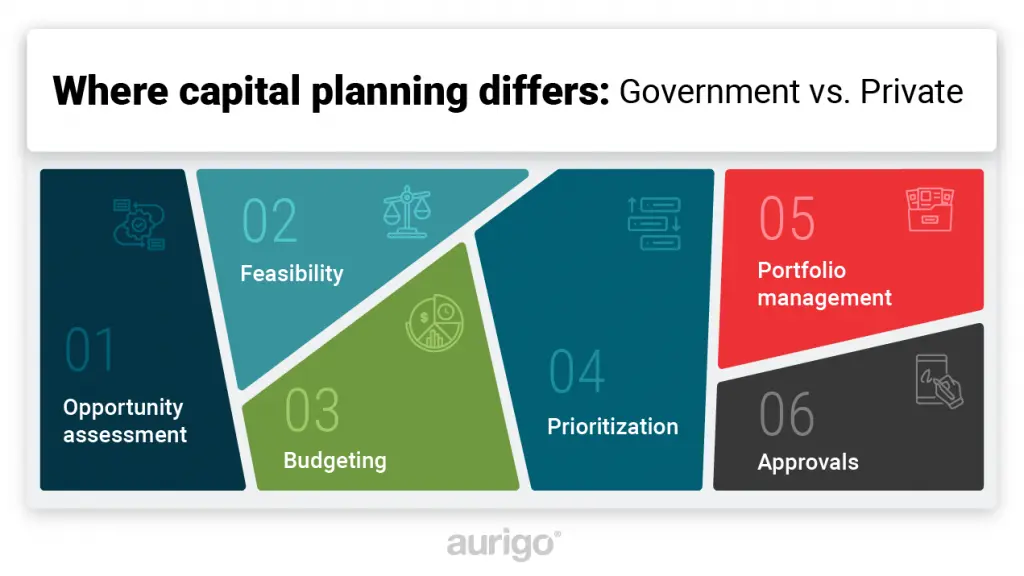
How government and private entities navigate capital planning
Capital planning typically follows a similar sequence of stages, from identifying opportunities to approving investments. But the way each sector navigates those stages is determined by distinct priorities and constraints. Government and private entities normally operate with different timelines, decision frameworks, and accountability structures. What follows is a closer look at how these differences play out across each phase of the capital planning process.
1. Opportunity assessment
Before any capital project moves forward, the question isn’t just ‘can we do this?’. It’s ‘should we?’. That answer rarely comes easily. Across both government and private sectors, opportunity assessment is a tailored blend of strategic intent and real-world constraints. For government agencies, this could mean identifying service gaps, societal needs, and policy priorities, using inputs such as infrastructure condition, demographic trends, and environmental risks. On the other hand, the private sector often translates business goals into growth roadmaps, guided by operational audits, market shifts, and emerging technologies.
This is the stage where capital strategy begins to take form, not simply around what gets built, but why. In either setting, AI and data-driven frameworks are playing a growing role, cutting through subjectivity and surfacing opportunities that align with broader mandates or strategic ambitions.
2. Feasibility analysis and cost estimation
What is considered ‘feasible’ depends on who’s asking. Every capital plan must pass a test where ambition confronts reality. This analysis always involves weighing costs against outcomes, but the nature of those outcomes creates the strategic divide. For a private firm, feasibility is defined by financial performance. For a government agency, the bar includes harder-to-quantify dimensions such as equity, environmental resilience, and public benefit.
Because these factors can shift under future scenarios, stress-testing early assumptions is essential. If a project survives this test, the next question is, can it be funded?’

3. Budgeting and funding allocation
Though the tension of allocating limited capital against high expectations is universal, the budgeting process is influenced by vastly different forces in each sector. Public-sector budgeting is a complex negotiation between project scope, political realities, and fiscal policy, with funding often layered from grants and appropriations subject to legislative cycles and public oversight. Conversely, private-sector capital planning is driven by market pressures and capital strategy. Here, the choice between using internal reserves, debt, or equity is a strategic calculation weighed against expected returns, tax impact, and financial flexibility. Despite their differences, both sectors must strike a balance between ambition and financial realism.
4. Project and investment prioritization
When faced with multiple viable projects, the process of choosing which comes first reveals a deep strategic divide. A private firm’s decision-making is often guided by a clear compass of financial metrics, such as Return on Investment (ROI) and Net Present Value (NPV), seeking quantifiable returns. In contrast, a government agency must translate more abstract goals of ‘public benefit’ and ‘environmental impact’ into defensible priorities, often through complex scoring models. External forces amplify this divide: The private sector races against market timing, while the public sector must align with legislation and policy mandates.
5. Portfolio and program management
How capital priorities are organized is as varied as how they’re set. While private portfolios are often built around specific business lines or investment themes, geared toward performance and speed (supporting launches, upgrades, or integrations where coordination matters and pace matters), public initiatives tend to span multiple agencies and are coordinated through policy mandates, oversight, and funding cycles. Public programs typically focus on sectors such as infrastructure, healthcare, or public safety, where dependencies are complex, and timelines are long. The scale may be similar, but the organizing logic behind the priorities is not.
6. Project review and approval
Approval processes are rarely simple and differ widely in pace, structure, and visibility. Whereas private organizations move faster, with decisions made by executives, boards, and key stakeholders, government agencies follow more layered paths. These may include public consultations, legislative reviews, and formal documentation, each shaped by fiscal policy and regulatory frameworks.
Regardless of the route, both organization types must navigate multiple checkpoints before capital is committed. Increasingly, AI tools are being used to synthesize stakeholder input, flag inconsistencies, and accelerate evaluations that were once entirely manual. Whether approvals happen in a boardroom or a public hearing, the scrutiny remains exacting.
Capital planning software for real-world complexity
Capital planning may follow different paths in the public and private sectors, but both demand tools that can handle complexity at scale. Aurigo Masterworks, designed for government agencies, and Aurigo Primus, tailored for private organizations, are built to support this complexity. These purpose-built tools offer end-to-end capital planning solutions, aligned with the distinct priorities of each sector, helping organizations make smarter, more accountable investment decisions.
You might like
Frequently asked questions
What is the main difference between public and private capital planning?
Public capital planning prioritizes societal needs, equity, and policy goals through complex budgeting and approval processes, whereas private capital planning focuses on financial performance, ROI, and strategic market timing.
How do feasibility analyses differ in public vs. private capital planning?
Public sector feasibility considers public benefit, environmental resilience, and policy alignment, while private sector feasibility is primarily assessed through quantifiable financial outcomes.
Why is budgeting different between the public and private sectors?
Public budgeting is influenced by legislative cycles, grants, and public oversight, making it more multifaceted, while private budgeting leverages strategic capital allocation tied to returns and financial flexibility.