

Blog
The ethics of speed: AI governance in capital planning
AI is accelerating capital planning decisions, but speed without governance introduces its own risks. This article examines how facility owners can move faster without sacrificing transparency, traceability, or control by building governance into the AI platform from the ground up.


Facility owners are in the middle of a genuine acceleration. Monthly spending on programs such as data center construction now exceeds $14 billion, and the organizations delivering these programs are under relentless pressure to compress timelines, optimize portfolios, and make confident decisions earlier in the cycle. AI has become the natural answer to that pressure, and for good reason. When intelligence is built into a capital planning platform from the ground up, teams can do in hours what once took weeks.
But for speed to be sustainable, it must be governed. Governance provides the structure that makes consistent execution possible.
What does governed AI actually mean in capital planning?
Governance in an AI capital planning platform for facility owners is not about slowing things down. It is about ensuring every decision the system surfaces can be trusted, traced, and acted on with confidence.
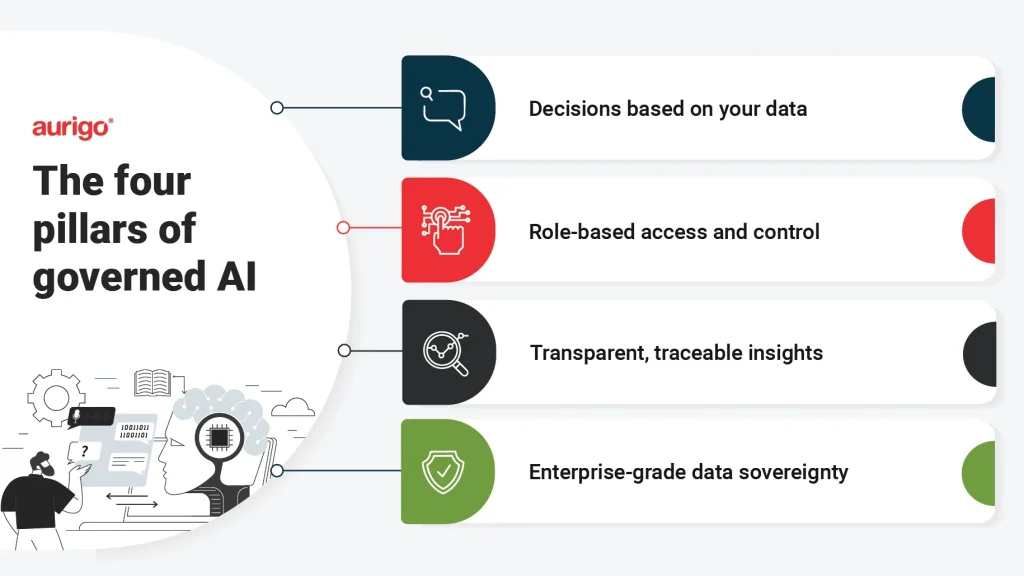
There are four dimensions where this matters most.
Decisions grounded in your data, not the market's
An AI-native capital planning platform connects directly to your portfolio, negotiated vendor contracts, site schematics, and historical cost performance. The intelligence it generates is specific to your organization. When your portfolio planning platform draws on that proprietary context rather than generic industry averages, the output is not just faster, it is significantly more accurate. Forecasts reflect your actual negotiated rates. Scenario modeling is anchored in your contract history, not probabilistic estimates derived from public benchmarks.
Access that reflects organizational authority
Speed should not flatten organizational structure. In a well-governed capital planning platform, the intelligence layer respects the same access controls that govern everything else. Sensitive financial insights, margin data, and bid intelligence are surfaced to the right people, not because of where a file is stored, but because the system understands who is authorized to see what. A conversational query does not become a backdoor to information that should be handled by procurement leadership.
Traceability that builds institutional confidence
The value of a billion-dollar recommendation is only as strong as the reasoning behind it. An AI capital planning platform built on explainability means every forecast, risk flag, and scenario output can be traced back to the specific contract, invoice, or data point that influenced it. That traceability allows leadership to act on AI-generated insights with confidence and turns the system into an auditable asset rather than a black box.
Sovereignty that protects competitive advantage
Your capital program contains some of your most competitively sensitive data, including vendor strategies, negotiated rates, and site intelligence built up over years of delivery. A truly AI-native platform keeps that data within a closed, enterprise-grade environment isolated from shared infrastructure and dedicated exclusively to your organization across both storage and compute. The intelligence works exclusively for your organization.
The platform built for this balance
Primus Plan is an AI-native capital planning platform built for facility owners who need to move quickly while staying in control. Intelligence is built into every workflow, helping teams plan, prioritize, fund, and deliver capital programs with greater confidence.
Lumina, Aurigo’s intelligence layer, operates within those workflows across three modes:
- Assist, which surfaces answers from across your data in plain language
- Predict, which identifies risks, delays, and overruns before they materialize
- Execute, which moves from insight to action within the system of record, always with a human in the loop.
Governance is not separate from AI. It is built into Lumina’s architecture, with auditability, role-based access, security, and explainability serving as foundational design principles rather than afterthoughts.
The result is a portfolio planning platform where your team can simulate supply chain disruptions, model funding shifts, and compress decision cycles quickly, while the authority to commit capital, approve strategy, and set direction remains exactly where it should be—with your leadership. With Lumina, organizations can move faster while maintaining control, governance, and data sovereignty.
The most capable capital programs are not choosing between moving quickly and staying in control. They are building on platforms where those two priorities reinforce each other. When AI operates natively within your capital planning workflows, grounded in your data, governed by your access rules, and traceable to your contracts, speed becomes something you can scale with confidence. That is what an AI-native capital planning platform for facility owners should deliver: faster decisions supported by transparency, governance, and confidence.
You might like

Frequently asked questions
How does an AI-native platform differ from one that uses AI as an add-on?
When AI is native to the platform, it has direct access to the full context of your capital program, including contracts, schedules, budgets, and risk history. It also operates within your existing workflows rather than alongside them. That means outputs are grounded in your actual data, actions can be taken within the system of record, and governance controls apply to AI-generated insights in the same way they apply to everything else. An add-on AI tool works at the edges. A native intelligence layer works at the center.
How can we trust AI forecasts for billion-dollar decisions?
Lumina is built on explainability by design. Every forecast or risk alert includes a traceable citation to the specific contract, invoice, or historical data point that informed it. Your team is never working from a recommendation without understanding its source. That auditability is what makes AI a genuine decision-support tool rather than a risk to confidence.
How does the platform protect competitively sensitive data?
Primus Plan operates within a closed, enterprise-grade environment with strict data isolation. Your proprietary contracts, rates, and vendor strategies are never transmitted to public models or shared infrastructure. Storage and compute resources are provisioned on a per-client basis, guaranteeing complete isolation of your data from other organizations at every stage of processing.
How does the system handle access to sensitive financial data?
Lumina applies your existing role-based access controls not only to files but also to the intelligence they generate. Sensitive margin data, bid analytics, and procurement insights are surfaced only to stakeholders with the appropriate authorization, regardless of how or where the question is asked. The AI does not create new access; it respects the access your organization has already defined.