
Blog
Build back stronger: How to improve capital program delivery
Capital program delivery is shifting from fragmented, reactive processes to integrated, data-driven decision environments. By improving visibility, aligning planning with execution, and strengthening governance, agencies can deliver infrastructure faster, with greater accountability and long-term efficiency.


Capital program delivery is entering a period of transformation. As infrastructure investments increase and expectations around transparency and outcomes rise, agencies must rethink how programs are planned, governed, and executed.
Delivering projects is no longer enough. Agencies must deliver them faster, more efficiently, and with greater accountability. This shift requires moving beyond fragmented systems and reactive processes toward a more connected, data-driven approach to capital program management.
Why capital program delivery needs to evolve
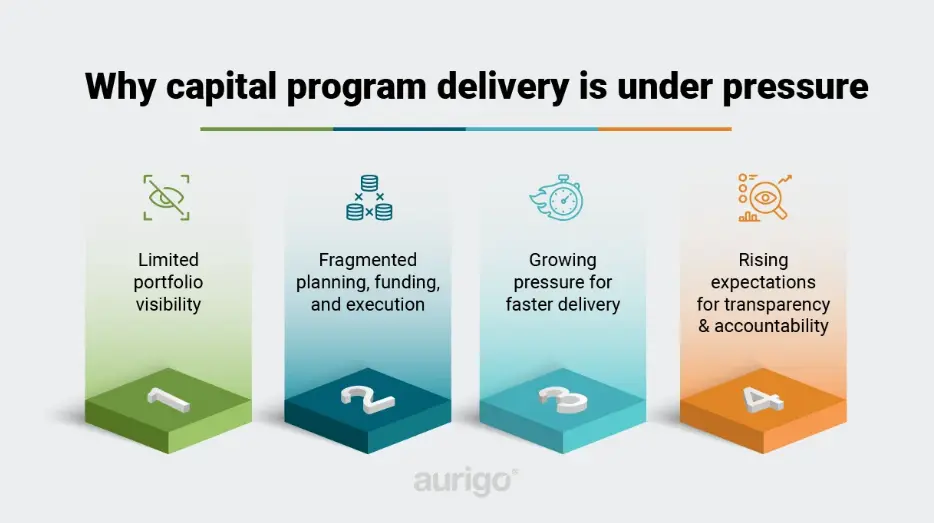
Across public infrastructure programs, agencies face a common set of challenges:
- Limited visibility into portfolio performance
- Disconnected planning, funding, and execution processes
- Increasing pressure to deliver projects faster
- Growing expectations for transparency and accountability
Traditional delivery models struggle to keep pace with these demands. When data is siloed and decision-making is delayed, projects are more likely to experience cost overruns, schedule delays, and reduced public confidence.
What ‘building back stronger’ really means
Building back stronger is not just about increasing investment—it is about improving how capital programs are delivered.
This requires a shift toward:
- Integrated planning and execution
- Real-time visibility into performance
- Data-driven decision-making
- Stronger governance and accountability frameworks
Agencies that adopt these principles can move from reactive program management to proactive delivery.
Key pillars of a stronger capital program delivery
1. Connect planning, funding, and execution
Capital programs often operate across disconnected systems. By integrating planning, budgeting, and project execution in a single environment, agencies gain a unified view of program performance and can make more informed decisions.
2. Improve visibility across the portfolio
Portfolio-level visibility allows agencies to identify risks early, understand dependencies, and prioritize resources effectively. Without this visibility, issues remain hidden until they escalate.
3. Enable data-driven decision-making
Modern capital program delivery relies on timely, accurate data. With access to real-time insights, leaders can evaluate trade-offs, respond to changing conditions, and align investments with strategic priorities.
4. Strengthen governance and accountability
Clear processes, standardized workflows, and transparent reporting improve oversight and ensure accountability. This is especially critical in publicly funded programs where trust and compliance are essential.
5. Increase delivery speed without increasing risk
Faster delivery should not come at the cost of control. By using connected systems and predictive insights, agencies can accelerate project timelines while maintaining financial discipline and operational integrity.

The role of technology in modern capital program delivery
- Monitor performance in real time
- Improve coordination across teams and stakeholders
- Identify risks before they impact outcomes
- Deliver projects with greater predictability
By replacing fragmented tools with connected systems, agencies can build the foundation for long-term program success.
Conclusion
Building back stronger requires more than increased funding—it requires a fundamental shift in how capital programs are delivered.
Agencies that invest in integrated systems, real-time visibility, and data-driven decision-making will be better positioned to deliver infrastructure projects efficiently, transparently, and at scale.
The future of capital program delivery belongs to organizations that can combine discipline, visibility, and speed to meet growing infrastructure demands.
You might like

Frequently asked questions
What does “build back stronger” mean in capital program delivery?
It refers to improving how infrastructure programs are planned and executed by increasing visibility, strengthening governance, and enabling data-driven decision-making.
Why do traditional capital delivery models fall short?
They rely on fragmented systems and delayed reporting, which limit visibility and slow decision-making, increasing the risk of delays and cost overruns.
How can agencies improve capital program delivery outcomes?
By adopting integrated platforms, improving portfolio visibility, and enabling real-time insights, agencies can deliver projects more efficiently and with greater accountability.