
Blog
Navigating federal funding: Key challenges owners face in managing capital projects
Government agencies must adopt AI-enabled capital planning to manage federal funding complexity, ensure compliance, and maintain transparent oversight across multiyear infrastructure programs.


A state’s Department of Transportation (DOT) plays a key role in maintaining the nation’s infrastructure and supporting economic growth. Securing funding for new projects, however, is far from simple. DOTs often rely on federal and state resources, but meeting the complex requirements tied to these funds can be challenging. For Fiscal Year 2025, the federal government allocated $62 billion to a variety of infrastructure investments, funding over 60,000 capital projects nationwide. Large initiatives often depend on multiple funding sources, each designated for specific purposes with strict spending guidelines, making it even harder for DOTs to manage compliance and eligibility. Navigating these financial constraints requires DOTs to carefully align project expenses with the appropriate funding streams, ensuring compliance while maximizing available resources. Mismanaging these allocations can result in delays, inefficiencies, or even lost funding, making it critical for DOTs to strategically manage the various “colors” of money they receive.
This article explores the key challenges DOTs face in managing federally funded projects and highlights strategies to simplify the process and maximize funding efficiency.
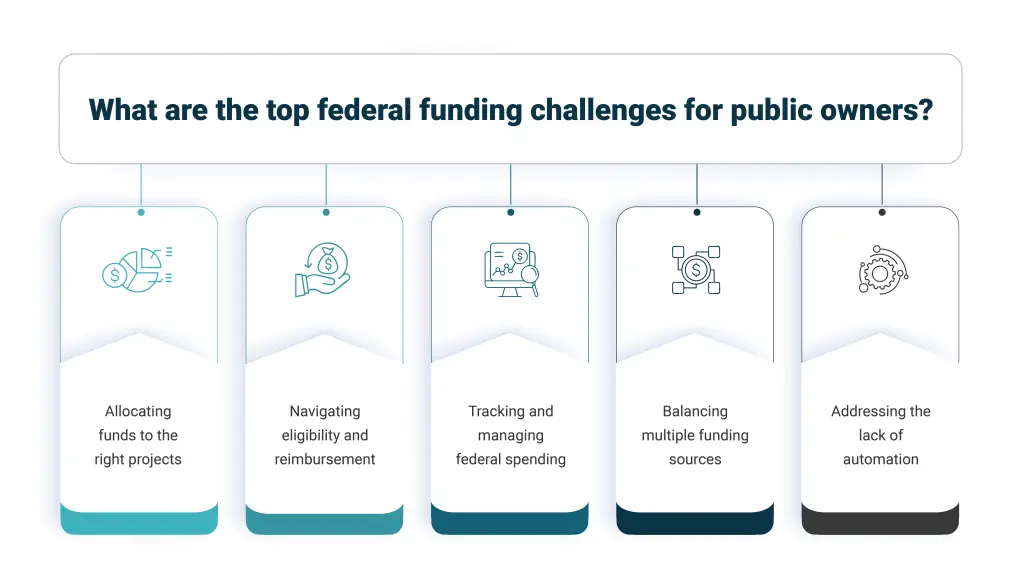
Top 5 federal funding challenges for owners
1. Aligning funding with the right projects
One of the biggest challenges is aligning federal funding with the right projects. Federal formula grants have strict eligibility rules, and the federal government will not fund any portion of a project that doesn’t comply. For example, if a specific material or component fails to meet the required standards, that part of the project will not receive federal reimbursement.
DOTs must secure authorization before starting a project and carefully manage schedules to maintain eligibility. The extensive paperwork and coordination required can quickly become overwhelming. If these processes aren’t handled effectively, agencies risk losing federal funds. Construction management software can help streamline the process by enabling owners to design accurate project schedules, track milestones, and maintain records to safeguard funding.
2. Navigating eligibility and reimbursement
Federal funding eligibility depends on several factors, such as proper authorization, adherence to strict timelines, activity type, and compliance with maximum federal share limits. Additionally, the USDOT won’t authorize funding for certain activities like town hall meetings, mileage reimbursements, hotels, or conferences despite their connection to transportation projects. State DOTs must carefully organize and verify expenses to meet program requirements, which demands a high level of organization and strong attention to detail. Failure to carefully manage expenses can result in delayed reimbursements or the rejection of funding.
Capital projects often face substantial budget overruns. For example, the Big Dig was originally planned with a $2.8 billion budget but ultimately cost $14.6 billion, a 500% increase. Similarly, the California High-Speed Rail project began with a $33 billion estimate and is now projected to exceed $100 billion.
Construction project management software can simplify and automate funding management, helping agencies submit paperwork on time and secure funding without last-minute issues.
3. Spending federal money and tracking its use
After a project is authorized and an agreement is finalized, federal funds must be utilized within a designated timeframe. Any unused funds remaining after the deadline may be reallocated to another state’s DOT. In fact, even after the project’s completion, agencies must submit final paperwork within a tight timeline to remain in good standing with their federal partner. Missing this window or failing to meet reporting requirements could result in the withdrawal or reassignment of funding.
Digitizing the federal aid and reimbursement process streamlines funding management, helping to prevent missed deadlines and lost funds. Cloud-based software with real-time updates keeps teams organized and ensures compliance.
4. Reconciling state, federal, and other funding sources
Managing large-scale infrastructure projects requires reconciling state, federal, and other funding sources, each with unique requirements. Therefore, ensuring the appropriate use of funds while adhering to different guidelines is not easy. Even a minor oversight can lead to missed reimbursement deadlines, unused funds, or failed audits.
Moreover, DOTs must also track which project elements are funded federally and which rely on state or local resources. They must meet various requirements, including ensuring consultants and contractors submit detailed invoices that comply with federal audit standards. Failure to do so can result in missed filing deadlines or unused funds. Manually managing this is both time-consuming and prone to error.
Government construction management software simplifies this process by tracking payments in detail, streamlining workflows, and preparing agencies for federal audits.
5. Lack of automation
While federal reimbursement programs help state DOTs stretch budgets, expand project scope, and tackle larger projects, they also create additional regulatory requirements, leading to heavy administrative workloads. Manual processes can slow down reimbursements, increase the risk of human error, and divert time and resources from project delivery.
When project managers and stakeholders spend too much time navigating these labor-intensive tasks, they lose focus on project delivery. A more effective approach is to integrate directly with systems like the Federal Management Information System (FMIS). Automation tools can simplify these workflows, ensuring that processes, billing, and reimbursements happen quickly and with fewer errors.
Final thoughts
Deploying a purpose-built software solution such as Masterworks Federal Aid Reimbursement can help government agencies manage and track all federal funding for their projects. By integrating directly with FMIS 5, it automates obligations and accelerates the billing and reimbursement process. While identifying the right partner to achieve these goals can be challenging, the benefits are substantial.
You might like




Frequently asked questions
What are the biggest challenges in managing federally funded capital projects?
Federally funded capital projects often involve complex compliance requirements, strict reporting standards, multiple funding sources, and tight timelines. Owners must manage documentation, audit readiness, cost tracking, and performance reporting while coordinating across agencies and stakeholders.
Why is compliance management critical for federal funding programs?
Answer: Federal funding requires adherence to detailed regulations, eligibility rules, and audit standards. Without centralized tracking and documentation, agencies risk delays, funding clawbacks, penalties, or reputational damage. Structured capital planning systems help ensure transparency and regulatory alignment.
How can capital planning software improve federal fund management?
Modern capital planning software centralizes funding sources, project budgets, contracts, and reporting requirements in one platform. With real-time visibility, automated workflows, and standardized documentation, agencies can improve accountability, reduce manual errors, and confidently manage federally funded portfolios.