
Blog
Why capital projects struggle with cost overruns and how local agencies can prevent them
Capital project management software helps local agencies reduce overruns with predictive scheduling, real-time field updates, and connected financial oversight. It improves transparency, strengthens accountability, and enables lean teams to deliver public infrastructure with greater control and confidence.


“Why do public projects often run late and over budget?”. This is not a new question—it’s one that has been asked for decades, and for good reason. Across the country, government agencies are scaling up to deliver vital community infrastructure, yet they continue to face challenges such as budget overruns, delayed schedules, and a disconnect between capital planning and project execution. In fact, 92% of capital projects fail to meet cost and schedule targets, draining resources that could deliver greater public value. A recent example comes from the City of San Antonio, where the ZerNona Black Cultural Community Center saw its budget rise from $3.5 million to nearly $6 million after contractor delays, material damage, and inflation forced the city to replace the contractor.
Projects such as this one highlight the challenges local governments face in keeping capital projects on track. Leadership changes can derail priorities, as new administrations shift funding or alter plans in progress. Inaccurate budget estimates often conceal hidden expenses, design errors, or delays, making forecasts unreliable. Scope creep from policy or regulatory changes, even when valid, can lead to costly rework. Contractor performance risks also loom large, where underperformance can stall progress and inflate costs. Additionally, local government agencies are frequently overstretched, with limited capacity for oversight. And when these projects run late or go over budget, it doesn’t just hit the balance sheet—it also undermines community trust. This is where modern construction management software makes a difference.
Turn inefficiencies into opportunities with capital project management software
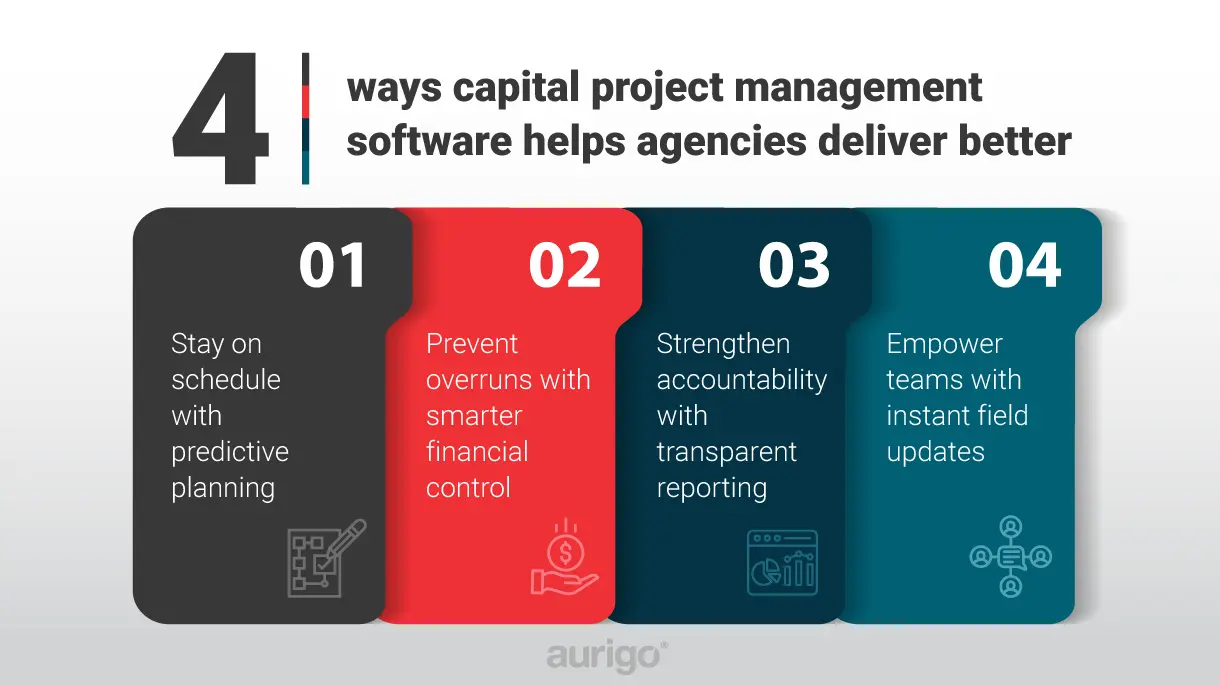
Deliver on time with predictive scheduling
Delays are among the most visible pain points in public works; they arise from fragmented planning, siloed teams, poor on-site communication, and the lack of real-time visibility into how tasks overlap. By applying predictive analytics to schedules, project management software enables local agencies to anticipate risks, such as material shortages, contractor delays, or weather disruptions, before they cascade. Centralized monitoring provides lean teams with a comprehensive view of progress at both the task and project levels. By reallocating resources proactively, governmental agencies can keep projects on track and ensure that the limited staff time is focused on the issues that matter most.
Control costs with smarter oversight
Capital project management software allows regional government agencies to centralize all financial data, such as budgets, contracts, invoices, and change orders, into a single, connected system. Its flexibility to integrate with existing financial tools ensures agencies can maintain their current systems while still gaining a unified view of costs and commitments. Advanced reporting provides clear, real-time visibility into how funds are being spent and where risks are emerging. One of its biggest advantages is tracking budgets versus actuals across every phase of delivery. Instead of discovering overruns when budgets are already exhausted, project managers receive early warning signals that enable them to make corrective decisions, reallocate funds, and maintain financial viability. This is an effective way for local agencies to bring financial transparency and accountability into every stage of project delivery.

Boost transparency with a public portal
Public-facing portals, often included in modern construction management software, address the challenge of eroding community trust by making progress visible. Citizens can see project progress and milestones without relying on fragmented updates or waiting for ribbon-cutting ceremonies; they can track how their taxpayer dollars are being put to work in real time. This transparency enables trust, creates a shared sense of accountability, and demonstrates that local governments are serious about delivering value. In an environment where credibility is as important as concrete, this feature is critical for strengthening public relationships.
Get real-time updates from the field
Collecting field data is often a weak link in an ongoing project, and delayed updates make it difficult to maintain an accurate picture of progress. Cloud-based construction management software allows staff, contractors, inspectors, and other stakeholders to enter daily logs, submit requests, and complete field inspections in real time and from any location. This eliminates bottlenecks and ensures decision-makers always have up-to-date data at their fingertips. For small, overstretched teams in local and regional governmental agencies, this capability is a force multiplier, enabling them to achieve enterprise-level efficiency without adding to headcount.
From questions to answers
Given the scale of the engineering and construction industry, small missteps can trigger massive losses, and small improvements can generate enormous public value. For public works directors and city leaders, the path forward means finding ways to deliver more with a leaner team and modernizing outdated systems. For project managers and engineers, it means keeping multiple projects aligned in one place for easy tracking and real-time reporting.
Aurigo’s Essentials Build is a purpose-built capital project management software solution that addresses these realities head-on. It provides the visibility, predictability, and accountability local government agencies need to overcome systemic inefficiencies by centralizing schedules, budgets, contracts, and field updates. With Essentials Build, cities and counties can finally answer the questions differently— by moving beyond firefighting delays to delivering infrastructure that is as promised, within planned resources, and worthy of public trust.
You might like

Frequently asked questions
Why do public capital projects often experience cost overruns?
Public capital projects often face cost overruns due to inaccurate early estimates, scope changes, contractor performance issues, inflation, and limited oversight capacity within local agencies. Leadership changes and fragmented project data can also disrupt planning and delay decision-making, making it harder to keep projects on schedule and within budget.
How can local agencies prevent cost overruns in capital projects?
Local agencies can reduce cost overruns by improving project visibility, strengthening financial oversight, and using predictive scheduling tools. Modern capital project management software helps agencies monitor budgets versus actuals, identify risks early, and coordinate teams more effectively across planning and construction phases.
What role does construction management software play in controlling project costs?
Construction management software centralizes schedules, budgets, contracts, and field updates in one system. This enables real-time tracking of costs, early identification of risks, better resource coordination, and transparent reporting, helping local agencies keep projects on schedule and within approved budgets.