
Blog
How AI copilots can supercharge your capital program management
AI copilots are redefining capital program management by augmenting human decision-making with real-time insights, automation, and predictive intelligence. They enable faster, more informed decisions across planning, execution, and portfolio oversight.


Artificial intelligence (AI) is making significant inroads into the construction industry, offering measurable benefits and marking a pivotal shift in the planning and execution of projects. According to a Deloitte study, AI and advanced data analytics can reduce construction project costs by 10–15%, cut timeline deviations by up to 20%, and lower engineering hours by 10–30%. The AI-driven construction market is projected to reach $151.1 billion by 2032, driven by improved efficiency and productivity. By optimizing project scheduling, resource allocation, and task management, AI reduces timelines and costs, fueling industry growth. AI copilots are driving this transformation by providing contextual summaries, interpreting data, and suggesting mitigation strategies, enabling faster data-driven decisions while saving time and effort.
They deliver measurable benefits across the full lifecycle of capital programs—enhancing planning, streamlining design, improving construction execution, and optimizing long-term maintenance. From real-time risk analysis to instant data access and intelligent automation, they help teams work more effectively at every stage. This article focuses on the top 3 areas where AI copilots are currently making the biggest difference, unlocking the most immediate value in cost, time, and decision-making.
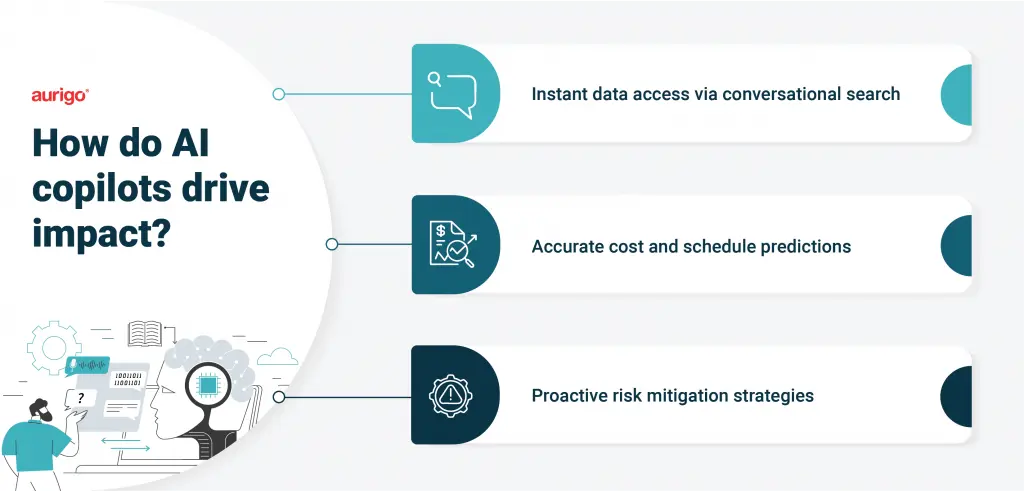
Top 3 ways AI-powered capital program management makes a difference
1. Instant access to data with conversational search
Accessing and accurately interpreting project documents remains a major challenge for managers, chief engineers, and field teams, especially in large government agencies. Even with standardized metadata and folder structures, the vast volume of files often buries key details, making data retrieval complex and adding uncertainty as well as compliance risks to the process.
Identifying connections between related documents is equally challenging, leading to inefficiencies in verifying modifications. On average, employees spend up to 7 hours a week searching for key project details instead of focusing on core tasks, significantly reducing productivity. Additionally, rework—often driven by misinterpreted data—accounted for 14% of avoidable construction costs, resulting in billions of dollars in losses. These inefficiencies not only slow projects but also inflate expenses.
Capital program management with AI transforms this process by enabling users to instantly find critical construction documents through conversational search using natural language queries, just like asking a colleague. Unlike traditional keyword-based searches, AI copilots understand context, permissions, and document relationships, ensuring precise results across vast data sources and repositories. Smart summarization further enhances efficiency by extracting key insights and linking related documents, reducing review time from hours to minutes. By allowing teams to interact with the tool, AI assistants make it easier to find information, enabling faster, better-informed decisions.
2. Accurately predict, assess, and manage project costs and timelines
Managing construction projects within budget and on schedule is a persistent challenge, with major capital projects experiencing an average 79% cost overrun and delays ranging from 6 to 24 months. Inaccuracies in initial planning and budgeting, including incomplete feasibility checks, inaccurate specifications, and lower bid estimates, often lead to unforeseen cost overruns and timeline disruptions.
The complexity of large-scale projects further complicates forecasting, as interdependent tasks make it difficult to anticipate the ripple effects of scope changes, design modifications, or stakeholder requests. Additional challenges arise from evolving requirements, environmental conditions, contractor performance issues, delivery delays, and resource constraints.
AI-powered capital program management addresses these issues by leveraging predictive analytics on historical project data to identify risks that contribute to budget overruns and schedule slips. It improves cost estimation, forecasts potential deviations, and suggests contingency strategies. With proactive change order impact analysis, project managers can assess budget and schedule disruptions before they escalate. Additionally, AI-driven schedule look-ahead features help teams anticipate and mitigate task dependencies, reducing the likelihood of compounding delays. As a result, agencies can enhance budget accuracy, streamline milestone tracking, and strengthen contractor oversight, ensuring more projects stay on track and within budget.

3. Identify, assess, and mitigate risks promptly
Many construction teams often identify issues too late, leading to unforeseen delays and cost overruns. Inconsistent assessments across projects delay mitigation efforts, as similar challenges are evaluated differently, impacting response effectiveness. Without clear insights into the most critical factors, decision-making slows, forcing teams to spend excessive time identifying threats instead of focusing on strategic mitigation.
AI assistants provide real-time risk assessment scoring and predictive analytics to identify and mitigate threats before they escalate. By analyzing historical data, cross-project trends, and key factors, such as contractor performance, seasonal patterns, and change order impacts, these systems help teams prioritize risks and take timely action, ensuring better project control. Predictive alerts provide early warnings of emerging issues, enabling teams to minimize or even prevent their impact. At the same time, accuracy indicators assess data reliability, helping teams make faster and more informed decisions. Through automated analysis and tailored mitigation strategies, copilots enhance response effectiveness, while trend insights reveal root causes and long-term patterns, preventing recurring issues. By integrating AI-driven intelligence, construction firms can shift from reactive to proactive risk management, ensuring project stability, minimizing delays, and improving financial outcomes across their portfolios.
Final thoughts
As the construction industry adopts digital solutions, intelligent assistants such as Aurigo Lumina are helping teams manage complexity more effectively. Built with construction-focused LLM and ML models, it provides real-time variance predictions and integrates seamlessly with Aurigo Masterworks as well as external systems. Role-based access ensures that only authorized stakeholders can interact with the data. All information remains private—it is never shared externally, used beyond its intended environment, or leveraged to train external models. As AI continues to evolve, its expanding role in construction will enable smarter and more resilient project execution, ensuring data integrity, security, and informed decision-making at every stage.
You might like


Frequently asked questions
Why does project execution often cause delays?
Execution delays are typically caused by poor coordination, limited visibility, and delayed updates from the field, making it difficult to respond quickly to issues.
How can organizations improve execution speed?
By enabling real-time visibility, improving stakeholder coordination, and adopting integrated systems, organizations can reduce bottlenecks and accelerate delivery.
What role does technology play in project execution?
Technology connects data, workflows, and teams, enabling faster decision-making, better
coordination, and more predictable project outcomes.