
Blog
Why traditional capital planning fails modern manufacturing industrial leaders
Traditional capital planning models are failing modern manufacturing leaders amid cost volatility, utility delays, labor shortages, and fragmented data. AI-powered portfolio planning enables manufacturers to model scenarios, manage risk, and align capital investments with long-term strategic growth.


For decades, industrial capital planning was a linear exercise in efficiency. Today, it is a strategic maneuver in resilience. A surge in reshoring, nearshoring, and private sector investment is driving U.S. manufacturers to restructure their supply chains. This shift is exemplified by the semiconductor sector, which is projected to grow at a 7.5% CAGR between 2025 and 2030.
As capital programs scale in size and interdependence, manufacturers are increasingly turning to AI-powered capital planning software to move beyond static planning models and enable adaptive, portfolio-level decision-making. Leaders face an urgent need to plan, modernize, and strategically expand their facilities. However, most organizations are attempting to meet these complex demands using obsolete tools.
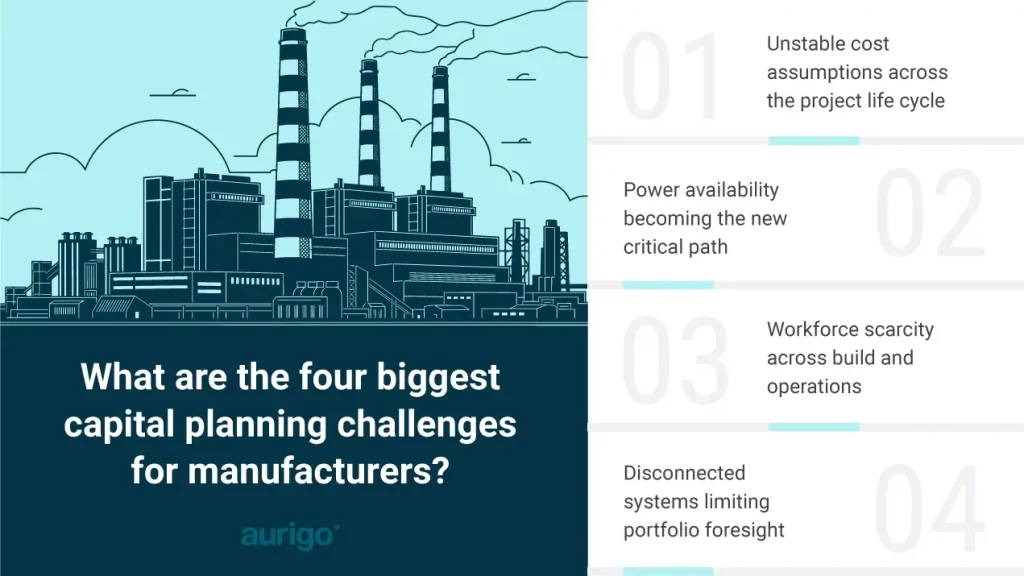
What are the four critical bottlenecks stalling capital projects in the manufacturing industry?
Recent industry data confirms that U.S. capital projects face operational headwinds defined by historic cost increases and labor scarcity. The following four factors represent the primary risks to project delivery.
1. The volatile cost baseline
- Operational impact: This volatility means material prices are no longer fixed variables but dynamic risks that fluctuate weekly.
- Planning challenge: Traditional static budgets cannot accommodate this variance. Without the ability to model multiple cost scenarios in real time, owners are forced to carry excessive contingency funds or face immediate budget overruns, underscoring the growing importance of predictive analytics for capital projects.
2. Utility interconnection delays
- Operational impact: A completed facility cannot operate without a substation. These extended wait times force owners to delay start-up dates well beyond the construction timeline.
- Planning challenge: You cannot build a schedule around an unknown utility connection date. Planners must now treat power availability as a critical path constraint, modeling multiple connection timelines to align capital spend with uncertain utility schedules.
3. The skilled labor deficit
- Operational impact: This deficit creates a dual bottleneck, gagging both the construction trades required to build facilities and the operational teams needed to run them.
- Planning challenge: A schedule is only as good as the resources available to execute it. Planners can no longer assume labor availability; they must actively model resource capacity across the entire portfolio to prevent simultaneous projects from competing for the same limited workforce. That, in turn, requires visibility into portfolio-level risk trends, not just individual project schedules.
4. Fragmented systems and portfolio blind spots
- Operational impact: The issue is not data availability, but data fragmentation. While teams have excellent visibility into individual projects, that intelligence is trapped in isolated tools, making it impossible to aggregate a reliable portfolio-wide forecast.
- Planning challenge: You cannot optimize a billion-dollar program using isolated project data. Without a consolidated portfolio view, leaders cannot spot cross-project resource conflicts or reallocate capital strategically until the money is already spent.
Scale intelligently with AI-driven portfolios
- Allocate capital where it matters most: Use comprehensive project scoring to ensure every investment counts.
-
Plan smarter with AI: Simulate scenarios, assess trade-offs, and compare outcomes instantly to align with your business goals.
- Drive future-ready strategies: Optimize your portfolio to mitigate risk and control costs before they impact the bottom line.
The leaders who win the race to $1 trillion will not be the ones hoping for the market to calm down. They will be the ones with the visibility to navigate the storm.
You might like
Frequently asked questions
How has the critical path for capital projects changed recently?
Historically, the critical path was defined by how fast you could build or obtain permits. Today, the controlling path is often dictated by utility energization. As interconnection delays become the norm, power availability often determines operational readiness more than the pace of project execution.
How does AI improve capital planning reliability?
AI shifts planning from reactive to predictive. Instead of just tracking past spend, AI-powered platforms (such as Primus Plan) analyze historical data to forecast future risks. This allows leaders to pivot strategies rather than firefighting after a budget variance proactively.
Why is portfolio-level management better than project-level management?
Portfolio-level management focuses on strategy whereas project-level management focuses on execution. By aggregating data from all projects into a single ‘control tower’, executives can spot cross-project resource conflicts that isolated project tools miss.