
Blog
How to speed up project delivery with better execution
Faster project delivery depends on strong execution, enabled by real-time visibility, seamless coordination, and data-driven decisions. By standardizing workflows and connecting teams, organizations can reduce delays and deliver projects with greater speed and predictability.


Faster project delivery depends on execution discipline, not just planning. By improving coordination, visibility, and real-time decision-making, organizations can reduce delays and deliver projects with greater predictability.
Why does project execution often slow down
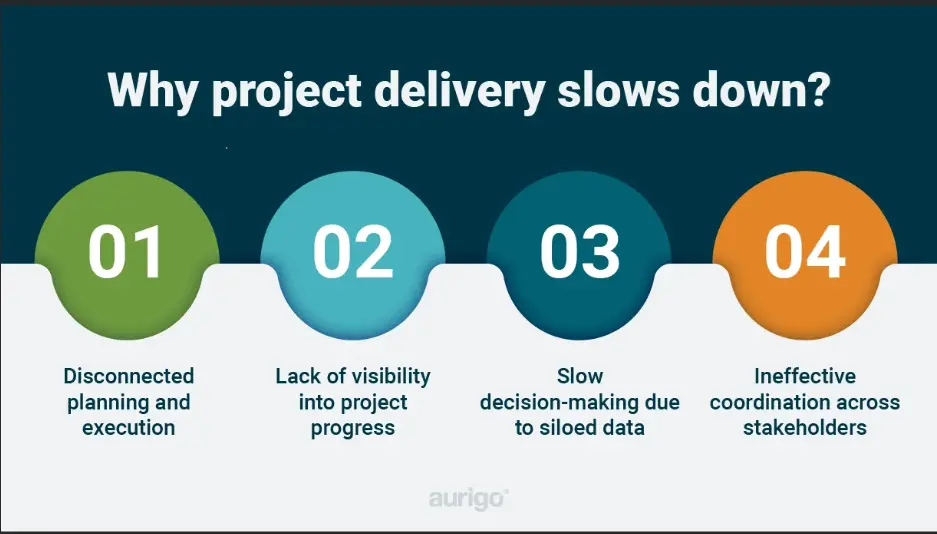
Delays in project delivery are rarely caused by a single factor. Instead, they emerge from execution challenges such as:
- Fragmented coordination between teams and stakeholders
- Limited visibility into real-time project progress
- Delayed updates from field teams
- Disconnected workflows across systems
When execution is not aligned and visible, issues remain hidden until they escalate, making it difficult to recover lost time.
What it takes to accelerate execution
Improving execution speed requires a shift from reactive management to proactive control.
This includes:
- Real-time visibility into project progress
- Seamless coordination across teams and stakeholders
- Faster, data-driven decision-making
- Standardized and connected workflows
With these capabilities, organizations can identify risks early and keep projects moving forward without disruption.
Key strategies to improve project execution
1. Enable real-time visibility across projects
Without up-to-date information, teams are forced to make decisions based on outdated data. Real-time visibility ensures that project status, risks, and dependencies are always clear, enabling faster and more informed actions.
2. Strengthen coordination across stakeholders
Project execution involves multiple teams, including contractors, field staff, and leadership. Improving coordination ensures that everyone operates with the same information, reducing delays caused by misalignment.
3. Capture field data instantly
Field updates are critical to understanding project progress. Mobile-enabled tools allow teams to capture and share data in real time, eliminating reporting delays and improving responsiveness.
4. Standardize workflows across teams
Inconsistent workflows create inefficiencies and confusion. Standardizing processes across planning, execution, and reporting ensures smoother operations and reduces bottlenecks.

5. Reduce delays through faster decisions
Execution slows when decisions are delayed. Providing leaders with timely, accurate data enables quicker approvals and interventions, keeping projects on track.
The role of technology in strengthening execution
Technology is essential to improving execution across capital programs. Modern platforms connect field data, project workflows, and reporting into a unified system.
This allows organizations to:
- Monitor progress in real time
- Improve communication across teams
- Identify and mitigate risks early
- Maintain control while accelerating delivery
By replacing disconnected tools with integrated systems, organizations can build a more efficient and responsive execution environment.
Conclusion
Speeding up project delivery is not just about better planning—it is about executing with clarity, coordination, and control.
Organizations that invest in real-time visibility, connected workflows, and data-driven execution will be better positioned to reduce delays, improve efficiency, and deliver infrastructure projects with greater confidence.
The future of project delivery depends on how effectively execution is managed.
You might like



Frequently asked questions
Why does project execution often cause delays?
Execution delays are typically caused by poor coordination, limited visibility, and delayed updates from the field, making it difficult to respond quickly to issues.
How can organizations improve execution speed?
By enabling real-time visibility, improving stakeholder coordination, and adopting integrated systems, organizations can reduce bottlenecks and accelerate delivery.
What role does technology play in project execution?
Technology connects data, workflows, and teams, enabling faster decision-making, better coordination, and more predictable project outcomes.