

Blog
Understanding IIJA: How it is transforming infrastructure delivery
The Infrastructure Investment and Jobs Act (IIJA) marks a structural shift in how infrastructure is funded and delivered. Agencies must adopt data-driven planning, modern systems, and disciplined execution to fully realize its impact.


The Infrastructure Investment and Jobs Act (IIJA) represents one of the most significant federal infrastructure investments in recent history. With billions allocated across transportation, utilities, and public works, it has created unprecedented opportunities for agencies to modernize and expand infrastructure.
However, funding alone does not guarantee successful outcomes. To fully realize the benefits of IIJA, agencies must rethink how infrastructure programs are planned, managed, and delivered.
What IIJA means for infrastructure programs
IIJA is not just about increased funding—it introduces new expectations around:
- Faster project delivery timelines
- Greater transparency and accountability
- Efficient utilization of funds
- Improved coordination across stakeholders
Agencies must ensure that investments translate into measurable outcomes, making execution as critical as funding.
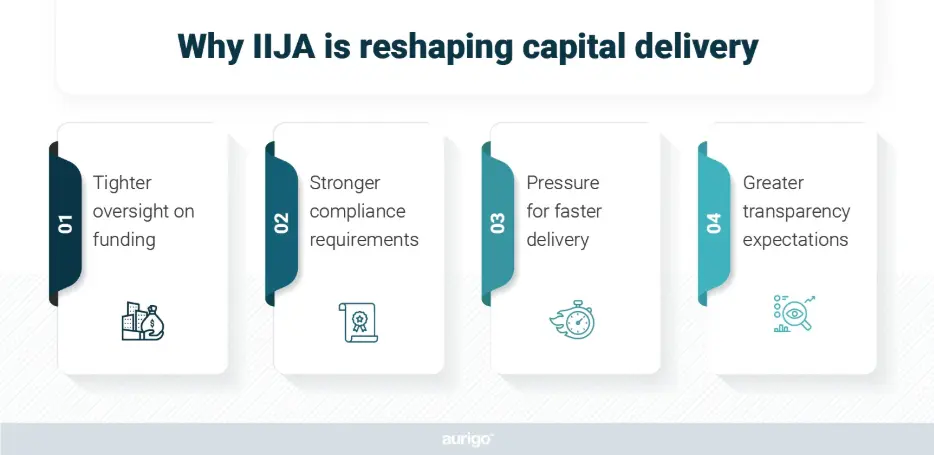
Why IIJA is driving a shift in capital program delivery
With large-scale funding comes increased scrutiny. Agencies are now expected to:
- Track how funds are allocated and spent
- Demonstrate compliance with federal requirements
- Deliver projects within defined timelines
- Provide visibility to stakeholders and the public
Traditional, fragmented systems are not equipped to meet these expectations. This is driving a shift toward more integrated and data-driven approaches.

Key challenges in implementing IIJA funding
1. Managing complex funding streams
IIJA funding often comes with multiple conditions, timelines, and reporting requirements. Managing these complexities manually can lead to inefficiencies and compliance risks.
2. Aligning planning with execution
Agencies must ensure that projects selected during planning can be delivered effectively. Misalignment between planning and execution can result in delays and underutilized funds.
3. Ensuring transparency and accountability
Public agencies are under increasing pressure to demonstrate how funds are being used. Without clear visibility into program performance, maintaining trust becomes difficult.
4. Scaling delivery capacity
With a surge in projects, agencies must manage increased workloads without proportional increases in staffing. This requires more efficient systems and processes.
How agencies can maximize IIJA impact
1. Adopt integrated capital program management
Connecting planning, funding, and execution in a single system enables better decision-making and improved program oversight.
2. Improve visibility across programs
Real-time insights into project performance help agencies identify risks early and ensure projects stay on track.
3. Enable data-driven decision-making
Access to accurate, timely data allows leaders to prioritize investments and adjust plans as conditions change.
4. Strengthen compliance and reporting
Structured workflows and centralized data simplify compliance with federal requirements and improve audit readiness.
5. Increase delivery efficiency
By streamlining processes and improving coordination, agencies can accelerate project timelines while maintaining control.
The role of technology in IIJA success
Technology is a key enabler in managing IIJA-funded programs. Modern platforms provide:
- Centralized data and workflows
- Real-time visibility into performance
- Improved coordination across stakeholders
- Enhanced reporting and compliance capabilities
By replacing manual processes with integrated systems, agencies can ensure that funding translates into successful project outcomes.
Conclusion
IIJA presents a once-in-a-generation opportunity to transform infrastructure. But success depends on more than funding—it requires disciplined execution, strong governance, and modern technology.
Agencies that adopt integrated, data-driven approaches will be best positioned to deliver projects efficiently, maintain accountability, and maximize the long-term impact of IIJA investments.
You might like



Frequently asked questions
What is the Infrastructure Investment and Jobs Act (IIJA)?
IIJA is a major federal initiative that provides funding to modernize and expand U.S. infrastructure across transportation, utilities, and public works.
What challenges do agencies face with IIJA funding?
Agencies must manage complex funding requirements, ensure compliance, improve transparency, and deliver projects faster while handling increased workloads.
How can agencies maximize the benefits of IIJA?
By adopting integrated systems, improving visibility, and enabling data-driven decision-making, agencies can deliver projects more efficiently and ensure effective use of funds.