
Blog
Turning data into decisions with AI’s growing role in public sector capital planning
AI is reshaping public sector capital planning with real-time insights, scenario modeling, and predictive risk analysis. It helps agencies make faster, more defensible portfolio decisions across complex infrastructure programs.


Imagine if the leaders of public-sector projects could assess their capital investments with the same level of certainty as private-sector executives when forecasting financial results.Government agencies today must contend with issues such as climate risk, infrastructure modernization, workforce capacity building, and compliance with laws and regulations, all at once. The rising need for accountability and the associated pressure leave no room for anything but precise decisions.
Meanwhile, there are also rising expectations regarding financial rigor. In every industry, finance leaders have transitioned from experimenting with AI to incorporating it into their daily operations. Whereas in 2024, only 7% of CFOs were using generative AI for more than 5 finance use cases, by 2025, this number had increased to 44%.
Teams in these public sectors that use capital planning software can no longer afford to remain blind to the shift toward broader acceptance of data-driven decision-making.
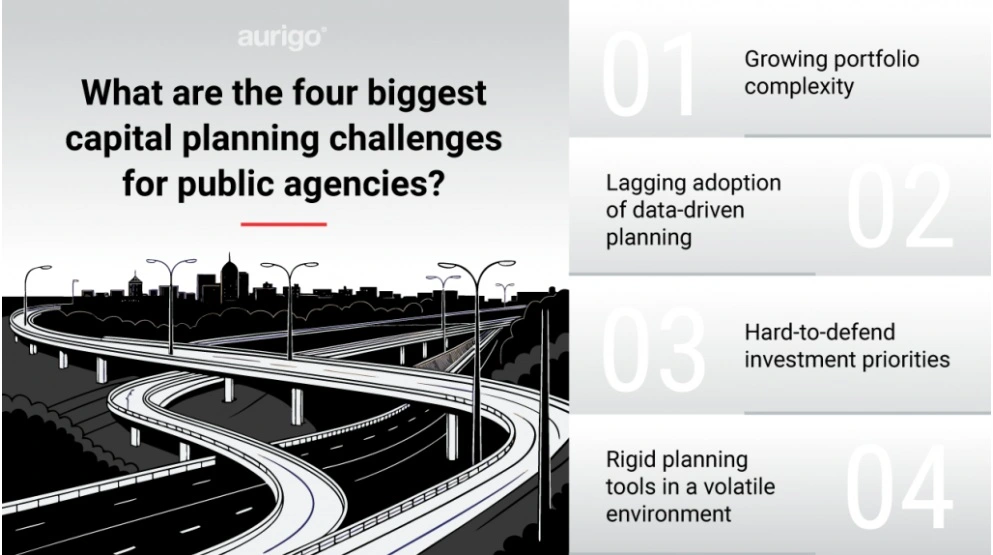
Why is capital planning reaching a breaking point?
There has always been considerable confusion and complexity surrounding the operations of public capital programs, and this has only worsened over the years. Delays in schedules, cost overruns, and high risk have always been persistent weaknesses, not only because teams lack data but also because critical insights are often too late to influence decisions.
Recent tariff shifts and trade policy uncertainty have further amplified cost volatility across materials and equipment, making it more challenging to maintain long-term budgeting assumptions. What used to be a simple, compliance-driven process has become an evolving management challenge that demands speed, clarity, and confidence at every stage of planning.As capital portfolios grow and project ticket sizes increase, these agencies have shifted their focus from isolated projects to overseeing a broader range of projects. They manage interrelated assets, delayed maintenance, legal requirements, climate exposure, and long-term service obligations across the entire portfolio.
To function effectively in this setting, agencies must have a capital project and portfolio management system that highlights what is significant in real time and facilitates efficient decision-making. Traditional planning tools were not designed to meet these demands.
1. Portfolio complexity has outgrown planning tools
When portfolio-level visibility is missing, minor disruptions can quickly cascade. Inflation, supply chain volatility, or accelerated asset deterioration don’t just affect one project—they destabilize funding assumptions, sequencing, and risk exposure across the entire capital program.
Legacy tools struggle in this environment. Spreadsheets and individual department systems were never designed to model interdependencies or surface risks that cross program boundaries. As a result, decision-makers lack a clear, real-time view of how changes in one area affect the broader portfolio, precisely when that insight is most crucial.
2. The human capital gap is widening as planning demands increase
The consequence is not a lack of information, but delayed insight. Critical signals are buried in reports or appear too late to influence funding and prioritization decisions. Manual analysis and static workflows further slow response times, making it difficult to maintain consistency across planning cycles.
Without automation and intelligent analysis, teams are forced to rely on judgment calls that are harder to validate, explain, or defend, especially under public scrutiny.
3. Capital prioritization has become difficult to justify and defend
Choosing which capital investments to fund has always been a complex process. Today, agencies must weigh transportation needs, water systems, safety improvements, and capacity expansion against competing criteria, including risk, equity, lifecycle cost, service impact, and public visibility.
When trade-offs cannot be evaluated systematically, prioritization becomes vulnerable to shifting assumptions and external pressure. Decisions may change from one planning cycle to the next, even when underlying needs stay the same.
Traditional planning tools lack the capacity to test scenarios or scoring models at scale. This makes capital decisions more difficult to explain to stakeholders, defend during audits, and sustain with confidence over time.
From reactive budgeting to strategic capital stewardship
Organizations that have introduced AI into financial and capital planning report measurable improvements, ranging from 15-20% gains in forecast accuracy to 10–15% reductions in planning effort. For government agencies, these gains translate into more stable capital programs, stronger alignment between funding decisions and service outcomes, and greater confidence in long-range investment strategies.
This shift represents more than efficiency. It marks a transition from short-term budget balancing to strategic capital stewardship, where agencies actively manage risk, trade-offs, and performance across the full portfolio.
Modern solutions, such as Aurigo Masterworks and Aurigo Lumina, demonstrate how AI can be effectively embedded into daily public sector operations. Masterworks provides an integrated foundation for end-to-end capital project and portfolio management. Lumina, Aurigo’s AI platform, helps teams surface risks, identify patterns, and work more effectively with large and complex datasets.
As data volumes increase across capital programs, access to timely, actionable intelligence becomes essential. Insights from AI-powered capital planning enable agencies to move beyond static reporting and respond proactively, thereby strengthening governance, improving resilience, and facilitating better decisions before issues escalate.
You might like
Frequently asked questions
How does AI improve public capital planning?
AI replaces static, spreadsheet-based planning with continuous analysis of cost, schedule, and asset data. It enables agencies to model scenarios, anticipate risk, and make defensible portfolio-level decisions as conditions change.
Why do traditional capital planning tools fail today?
Traditional tools rely on fixed assumptions and manual updates, making them too slow for volatile costs, workforce constraints, and infrastructure risk. Without real-time intelligence, risks stay hidden until budgets and schedules are already impacted.
Does AI replace human judgment in capital planning?
No, AI enhances professional judgment by accelerating analysis, revealing hidden patterns, and improving confidence in decisions over the long term.