
Blog
Water infrastructure demands a new approach to construction management
Water infrastructure projects are becoming more complex, requiring a shift from traditional construction management to more integrated, data-driven approaches. By improving visibility, coordination, and planning, agencies can deliver resilient and sustainable water systems.


Water infrastructure in the U.S. is facing critical challenges. Aging systems, growing populations, and extreme weather patterns are straining a vast network tasked with delivering safe drinking water, managing wastewater, supporting industries, agriculture, and flood control. Persistent leaks and system failures waste billions of gallons of water daily, compounding the crisis.
Recent Environmental Protection Agency (EPA) analyses highlight the scale of investment needed to address these issues. Drinking water systems alone will require $625 billion over the next 20 years for essential repairs and enhancements. Although the IIJA allocates over $50 billion for water construction improvements, this funding is insufficient to bridge the vast investment gap.
With budget constraints, strict regulations, and rising costs, water utilities face challenges in ensuring public health, sustainability, and economic resilience. Overcoming these requires adopting a construction management approach centered on efficiency, scalability, and long-term value, enabling utilities to adapt and meet their communities’ needs.
In this article, we will discuss some of the key challenges facing water utilities.
What are the key challenges faced by U.S. water infrastructure management?
Aging infrastructure and water loss
The U.S. water system is aging, with many pipes over 45 years old and some exceeding a century. Frequent leaks and failures are common, leading to the daily loss of 14–18% of treated drinking water. Based on EPA estimates, replacing and monitoring lead service lines alone could cost up to $839 million annually, emphasizing the scale of the issue. The continued use of outdated systems and the slow integration of modern technologies intensify the problem, making the need for system modernization even more urgent.
Funding gaps and public resistance
Most water infrastructure is funded by ratepayer fees, often falling short of covering maintenance and upgrading costs. Efforts to raise rates frequently face public resistance, leaving municipalities underfunded. Limited budgets at the federal and state levels worsen the issue, placing financial strain on local government agencies, which must also ensure costs remain affordable for the public.
Low technology adoption rates
Despite advances in construction technology, the water sector has been slow to adopt tools such as Building Information Modeling (BIM) and data analytics. Only 55% of infrastructure project owners use basic analytics regularly, and just 39% employ BIM. Long project life cycles, workforce resistance, inadequate training, and regulatory hurdles hinder technology integration. Moreover, the lack of digital input and reliance on manual systems hinder modernization efforts, delaying progress.
Financial strains and cost forecasting challenges
Rising construction costs—fueled by inflation, material shortages, and labor scarcity—have significantly diminished the purchasing power of allocated funds. Between 2017 and 2023, construction inflation soared by 41%, complicating long-term cost forecasting and destabilizing project budgets. Although public-private partnerships (PPPs) may provide additional funding, high interest rates and economic uncertainty limit private-sector investment. Furthermore, unpredictable subsurface conditions in water projects add financial risk, requiring more advanced planning and mitigation strategies.
Complex regulatory requirements
Water construction projects operate under a dense regulatory framework. Compliance with updates, such as the EPA’s Lead and Copper Rule, often requires costly upgrades. Federal funding programs, including the IIJA, mandate adherence to provisions such as the Build America, Buy America Act, which requires domestically sourced materials that are often scarce and expensive. These regulations increase complexity and project costs, underscoring the need for more efficient management practices.
To tackle these challenges, government agencies may digitize water infrastructure management to enhance efficiency and support sustainable practices. Federal initiatives support adopting construction management software to modernize oversight and ensure optimal resource use.
What are the advantages of digitizing water infrastructure management?
Long-term cost forecasting for better planning
Water capital programs are complex and multiyear, with costs fluctuating across design, construction, and operation phases. Advanced software enables predictive cash flow analysis for Capital Improvement Programs (CIPs), accounting for inflation, fiscal constraints, and shifting priorities.
Digitized infrastructure management incorporates lifecycle cost analysis to address immediate and long-term expenses, such as maintenance. Scalable solutions support projects of varying sizes and enhance collaboration, aligning plans with organizational goals. Agencies can refine forecasts and adapt to changing conditions by monitoring economic trends and supply chain challenges.
Real-time dashboards enhance decision-making by modeling funding scenarios, assessing risks, prioritizing projects, and tracking funding sources, facilitating efficient and robust infrastructure management.
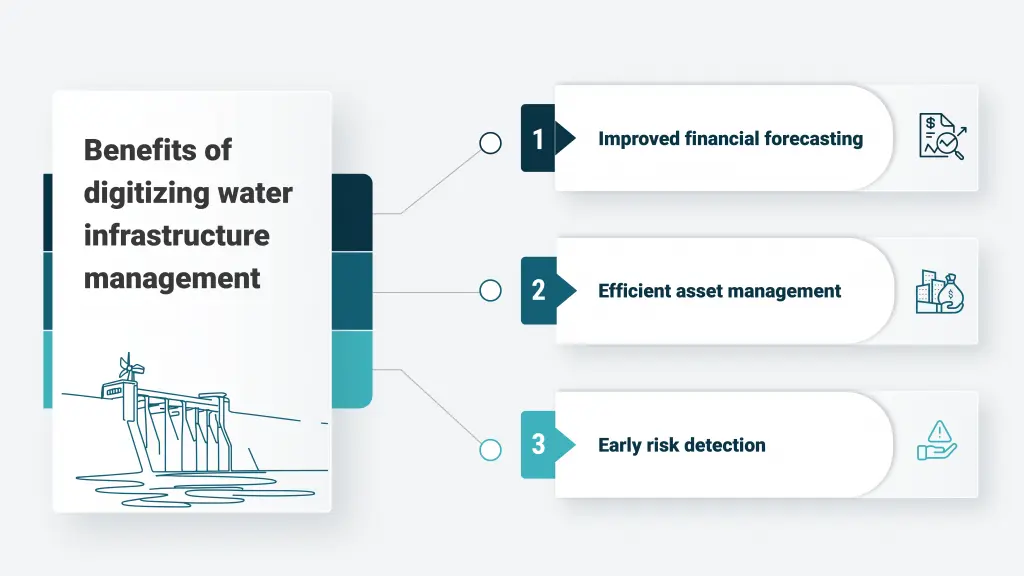
Advanced analytics for targeted capital asset management
Digital solutions with advanced analytics help utilities assess capital asset health, prioritize repairs, and plan maintenance efficiently. These tools provide precise data on asset conditions and lifespans by employing diagnostic technologies to monitor hard-to-reach assets. Targeted maintenance efforts extend asset lifespans, reduce leaks, and optimize resource utilization.
Advanced analytics also justify investments by offering data-driven insights into asset performance and funding needs. These tools enhance water conservation, detect abnormalities in distribution networks, and mitigate the risk of major failures, ensuring long-term sustainability despite aging systems and operational challenges.
Proactive risk management
Subsurface construction in water capital projects involves significant financial risks due to unknown conditions and geotechnical challenges. Standard testing methods cannot always assess these risks. A robust construction management software purpose-built for government agencies acts as an early warning mechanism to proactively identify and address potential risks.
These systems allow teams to adapt quickly to on-site changes by integrating real-time data, reducing delays, and preventing costly disruptions. They enhance project efficiency and minimize unforeseen complications in complex subsurface environments.
Building resilient water systems with a digital-first approach
In light of evolving market conditions and industry challenges, utilities must embrace new technologies and strategies. Solutions like PMIS (Project Management Information Systems) play a pivotal role in effectively addressing and mitigating these industry challenges. A KPMG report reveals that construction companies adopting such systems can realize a 7x return on investment by significantly reducing costs related to time and materials.
When evaluating various PMIS solutions, government agencies can consider Aurigo Masterworks to streamline processes, improve project prioritization, and build sustainable utilities to serve their communities effectively. Doing so will enable them to maintain the delivery of safe, clean, and affordable water to an increasingly urbanized U.S. population, ensuring long-term resilience and sustainability.
You might like
Frequently asked questions
Why does water infrastructure require a different approach to construction management?
Water infrastructure projects often involve aging systems, regulatory complexity, and long asset lifecycles. These factors require more coordinated planning, stricter compliance, and better long-term visibility than traditional construction approaches can provide.
What challenges do agencies face in managing water infrastructure projects?
Agencies must balance maintenance of existing assets with new construction, often under tight budgets and regulatory oversight. Fragmented systems and limited visibility make it difficult to manage risks and deliver projects efficiently.
How can modern construction management improve water infrastructure outcomes?
Modern platforms enable real-time visibility, better coordination, and data-driven decision-making. This helps agencies manage complexity, improve efficiency, and ensure long-term resilience of water infrastructure systems.