


According to a recent GAO report, the fiscal health of the U.S. federal government is approaching a potential fiscal cliff, with the national debt reaching $28.2 trillion as of September 30, 2024—equivalent to 98% of the economy. This situation arises when governments face a sudden financial crisis, forcing drastic measures due to shrinking revenues and rising expenditures. Key factors driving this risk include declining tax collections, economic stagnation, reduced federal and state aid, and escalating costs for infrastructure, pensions, and public services.
For government agencies, this could mean significant budget cuts, making it harder to fund essential infrastructure. To navigate these challenges, agencies must focus on structural budget balance, realistic revenue projections, and multiyear planning. If they can reduce risk, maintain clear visibility around budget and spending, establish clear accountability, and ensure the right personnel are in place, the chances of falling into a fiscal cliff would be significantly lower.
Strategies for avoiding the fiscal cliff
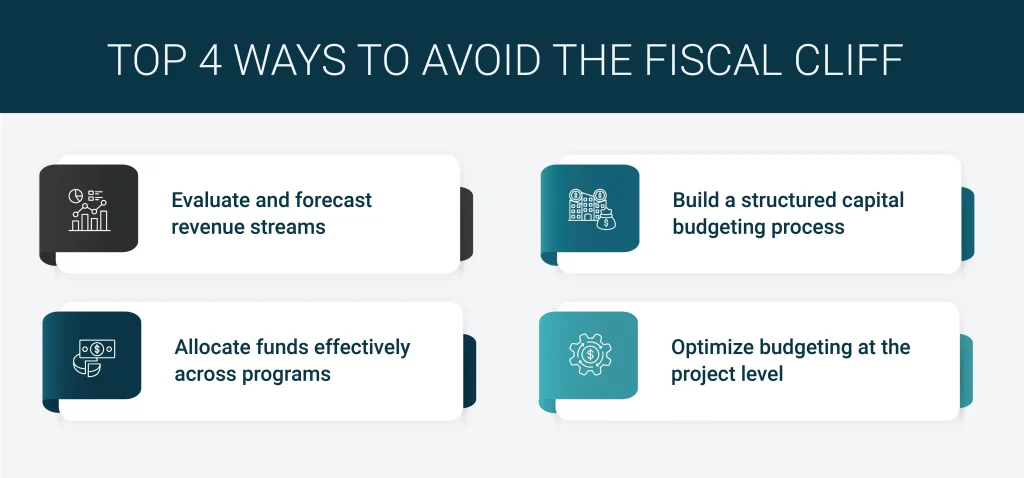
1. Assessment and projection of revenue streams
A key strategy to prevent the fiscal cliff is to assess and project the various revenue streams that fund government initiatives. Different sources, such as sales tax, property tax, and federal, state, and local funds, must be projected separately, as each may have specific usage restrictions. In many cases, infrastructure investments are not funded directly but through bond financing, which provides cash upfront but requires repayment over time, necessitating reliable funding sources far into the future. Accurately assessing these revenue streams allows agencies to proactively address potential shortfalls.
Finance directors determine how much debt an agency can take on, while owners ensure those funds are allocated effectively to meet infrastructure needs. At the same time, it is important to prioritize long-term financial planning, as large-scale initiatives often extend beyond a single budget cycle. Some agencies must accumulate funds over multiple years due to regulatory restrictions, while federally funded infrastructure often requires needs assessments, such as the Federal Highway Administration’s (FHWA) Statewide Long-Range Transportation Plan, to justify investments. Digitizing capital planning processes and integrating real-time data enables you to model and forecast various scenarios, helping to identify risks early that may lead to a fiscal crisis.
2. Allocating funding to programs
One of the most effective ways to navigate constraints is by prioritizing infrastructure needs when allocating funds. Government agencies must ensure that essential infrastructure receives financial support while balancing maintenance and new development to maximize long-term value. Centralizing all relevant information streamlines this process, making it easier to assess needs, optimize investments, and ensure accurate reporting on the use of federal funds.
With revenue projections in place, performance-based budgeting helps rank initiatives based on their alignment with strategic goals. When data is consolidated, projects can be evaluated more objectively, leading to better-informed choices that prevent financial mismanagement. A holistic funding approach ensures that resources are distributed efficiently across various infrastructure needs, supporting both immediate and future demands. Cross-asset prioritization further enhances resource allocation by evaluating projects across different infrastructure categories rather than treating them in isolation, thereby reducing inefficiencies that could lead to fiscal instability.

3. Capital budgeting process
The next step is structuring the capital budgeting process to ensure financial stability and compliance with federal, state, and local regulations. Agencies should consider whether their budgeting cycle is annual or biannual, as this impacts long-term infrastructure planning and funding distribution. They must also determine the most suitable budgeting approach (i.e., zero-based, performance-based, or incremental) to manage expenses effectively and prioritize projects, helping to avoid overspending that could lead to shortfalls.
Accounting compliance is another crucial factor, as many revenue sources have restrictions that require careful tracking of operating versus capital expenses. Fund-based accounting ensures proper allocation while adhering to legal and regulatory requirements. Additionally, defining the approval process and budget ownership is essential for clarifying who controls the budget and whether planners and program managers are actively involved in decision-making. This can streamline approvals and improve accountability, leading to a lesser scope of pitfalls in the future.
However, navigating these complexities through spreadsheets, paperwork, and manual methods can be overwhelming. Capital planning software simplifies the process by consolidating data, aligning financial sources with project needs, and ensuring regulatory compliance. It also enhances transparency, facilitates real-time budget tracking, mitigates cost overruns, and optimizes resource allocation —all crucial elements in preventing financial instability.
4. Project-level budgeting
After determining your overall budget, the next step is project-level budgeting. This is the process of assessing and prioritizing projects that can be completed within a given year based on fiscal capacity.
Efficient resource allocation helps balance priorities and constraints, ensuring projects stay on track without straining agency budgets.
Agencies must keep the budget flexible, as timelines may need to shift depending on budgetary constraints. This ensures that an infrastructure can proceed without unnecessary interruptions or scaling back. They must also have sufficient contingency funds in place to cover unexpected costs or changes in revenue.
Without a contingency budget, any unforeseen costs could lead to delays or compromise quality. Leveraging digital tools such as a capital planning software system streamlines this process by consolidating cost estimates, financial availability, and timelines into a single system. It supports data-driven decision-making, improving fund allocation while ensuring regulatory compliance and reducing the risk of budget shortfalls that could trigger a fiscal cliff.
Wrapping up
Successfully navigating and surviving the fiscal cliff requires government agencies to take a strategic, data-driven approach to financial planning. With AI-powered risk analysis, scenario planning, and real-time insights, Masterworks Capital Planning helps agencies optimize funds, connect stakeholders, and ensure efficient project execution. By embracing digital transformation and adopting proactive management strategies, agencies can mitigate risks, enhance fiscal stability, and make smarter infrastructure investments that support long-term economic growth.
You might like


Frequently asked questions
What does the "fiscal cliff" mean for government capital programs?
The fiscal cliff refers to the sharp funding shortfalls government agencies may face as temporary federal stimulus programs expire while infrastructure demands continue to grow. This creates pressure to reprioritize projects, manage tighter budgets, and maintain service levels with fewer available resources.
How can government agencies prepare for funding uncertainty?
Agencies can prepare by strengthening long-term capital planning, using scenario modeling to evaluate funding reductions, prioritizing high-impact projects, and improving financial forecasting. Data-driven planning tools help leaders compare trade-offs, align investments with strategic goals, and make defensible decisions under constrained budgets.
Why is modern capital planning software important during fiscal constraints?
Modern capital planning software provides centralized visibility into project costs, funding sources, risks, and portfolio performance. With real-time dashboards and scenario analysis, agencies can respond proactively to funding gaps, reduce inefficiencies, and optimize limited capital for maximum public value.