
Blog
Key reasons to use construction document management software systems
Construction document management software replaces fragmented, paper-based processes with structured, centralized systems. By improving access, version control, and collaboration, teams can reduce errors, maintain compliance, and deliver projects more efficiently.


Whether it’s the construction of a residential building or a large infrastructure project meant for public utilities, several stakeholders are involved. While owners, end users, contractors, and subcontractors, are deemed some of the key stakeholders in the construction management ecosystem, the construction life cycle involves estimators, designers, architects, vendors, suppliers, and several other contributors as well. Like any other project, collaboration and effective communication are keys to success in the construction ecosystem. The digitization of documents serves as a catalyst for collaboration and communication among these construction stakeholders.
Challenges associated with conventional construction document management
Conventionally, you may have been storing construction-related documents, from contracts to estimation documents, project progress documents, bids, etc., as physical paperwork in cabinets, in Excel, on desktops, or on external hard drives. Any stakeholder who wishes to gain access to any particular document might not find the most up-to-date one on time. Physically accessing these files can be a harrowing process for you, your teams, and other stakeholders. The lack of adequate information regarding the document and the inability to link it back to authorized personnel tend to contribute to errors, a lack of collaboration, miscommunication, unwarranted project delays, and increased risk for owners, which may cost them billions of dollars.
As an owner, it is critical that you have a robust document management system that enables easy documentation and prevents legal non-compliance and authorization conflicts.
How can construction document management systems help?
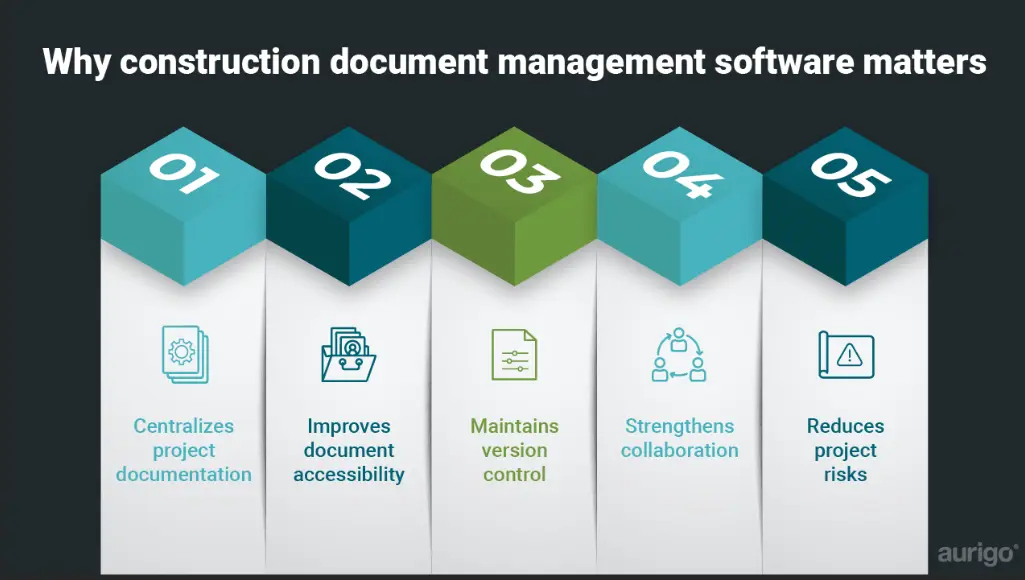
With the advent of construction document management software, the construction industry has undergone a tremendous transformation. This is true for both small and large capital infrastructure projects. Let’s discuss why it is indispensable for key construction stakeholders and for you, as owners, to use the right software solution to manage your documentation.
Reason 1 - Unified source of truth
Reason 2 - Risk reduction
Poor document management in construction leads to a high amount of rework, wasted productivity, siloed data, communication delays, leaks in safety and security, slow responses to change orders, as well as incomplete closeouts. These inefficiencies easily translate into financial and legal risks for the stakeholders involved. However, owners can stay prepared and proactively avoid such risks by implementing a document management system tailored to their needs.

Reason 3 - Data security and privacy
Construction-related documents are confidential and sensitive and should be kept from unauthorized access. Construction document management systems provide cloud storage where all the construction contracts and auxiliary documents can be safeguarded using systems that ensure the data security and privacy of all the documents.
Reason 4 - Easy accessibility
Whether you are a property owner, an agency responsible for construction execution, a contractor overseeing daily operations, or a project manager, the pain of tracing paper files and folders related to construction is not a new challenge for you. However, document management systems can take away these legacy constraints effectively. Since all construction-related documents are hosted in a cloud-backed environment, they can be accessed anytime, anywhere, and securely. With document management systems specifically built for the construction industry, you can bid goodbye to manual approval processes and access the latest bid document, updated contract, change order, spec sheet, and more at the click of a button.
Reason 5 - Easy and efficient audit trails
The term ‘audit’ conjures up a sense of urgency, complexity, endless explanations, and other stressful situations. The construction ecosystem is not an exception to these audits. Documentation related to different construction phases might get lost, shuffled, or become inaccessible when they are manually maintained. And during audits, this may pose unavoidable challenges for you. With robust construction document management systems, you won’t have the conventional fear of audits anymore. Document management helps you keep your documents organized with a clear history of the revisions, thereby making your life easier during an audit.
Reason 6 - Communication and transparency
Construction document management systems bridge the gap created due to the information silos existing among various stakeholders. For example, if there are changes in the design, they have to be adequately communicated to employees in the field. Proper document management helps remove the guesswork and makes the latest revisions to drawings and designs readily available, thereby saving time and resources. Digitally hosting all construction-related documents is far more beneficial, as these can be easily traced, updated, and accessed anywhere, anytime, by anyone. With a document management software system, you can even attach the relevant link or file to the document for more clarity for the end user. Also, any changes made to the document can be saved as historical data, which helps forecast any vulnerabilities in the project.
Final thoughts
From equipping you with a single source of truth and fostering excellent communication and collaboration to ensuring data security, construction document management software solutions have multiple key benefits.
Aurigo offers a comprehensive document management functionality that can help you streamline the entire construction process. You can upload, annotate, comment on, and get approval on any document for enhanced collaboration and communication across the execution teams and federal authorities. Connect with the experts at Aurigo today to learn more about document management systems.
You might like
Frequently asked questions
Why is bid management becoming a strategic function in construction?
Procurement decisions directly influence project outcomes, yet traditional bid processes often lack transparency and consistency. As projects grow in complexity, organizations are recognizing that structured, data-driven bid management is essential to ensure fair evaluation, reduce risk, and align contractor selection with long-term project objectives.
What challenges do traditional bid management processes create?
Manual and fragmented processes can lead to inconsistent evaluations, limited visibility into contractor performance, and delays in decision-making. Without standardized workflows, organizations may struggle to compare bids objectively, increasing the risk of selecting vendors based on incomplete or misaligned information.
How do digital bid management solutions improve project outcomes?
Digital platforms bring structure and transparency to the bidding process by centralizing documentation, standardizing evaluation criteria, and enabling real-time collaboration. This allows organizations to make more informed decisions, improve accountability, and streamline procurement timelines while maintaining compliance and fairness.