

Leadership insight
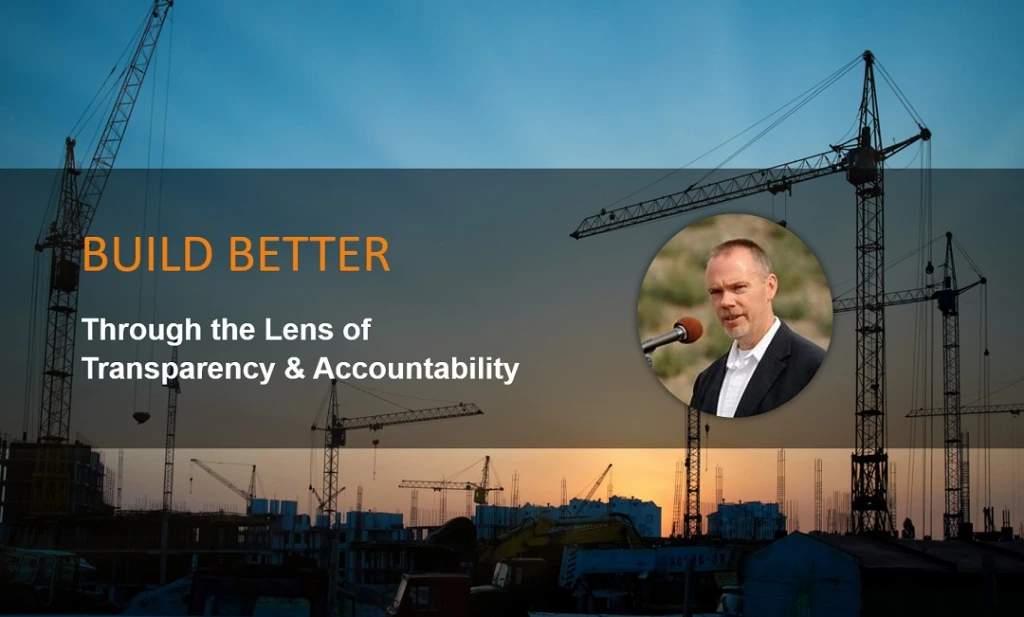
Build better: Through the lens of transparency & accountability
Building better infrastructure requires strong leadership, practical experience, and a commitment to smarter, more disciplined decision-making across capital programs.


As our nation winds closer to a significant infrastructure bill, anticipation by state and local government agencies continues to rise. The universal hope is that this investment will be a springboard for a true modernization of our roads, bridges, water/wastewater, energy, and communication systems.
It’s an exciting time…if your internal data infrastructure is equipped to handle the demand, and the parallel expectation of transparency and accountability.
A $2 trillion investment captures the attention of the public and brings with it all kinds of scrutiny by decision makers and the community. Just telling these groups that the investment will reap long-term benefits of improved access to services and goods and improved economic development, as well as more holistic benefits of health, safety, and quality of life is not enough.
Many government organizations look to their architectural, engineering and construction partners to deliver quality, productivity, and efficiency. Are you looking at your organization through the same lens?
The response to a few questions provides an assessment baseline. Are you managing capital projects with spreadsheets? Approvals by email? Do you have to re-enter data as projects move from design to construction to handover?
If the answer to any or all of these questions is yes, then you might need to prepare your data infrastructure to facilitate fast, efficient project delivery.
Capital planning and execution is all about data, or, more specifically, access to data. The many silos of conventional government-driven workflows create a fragmented flow of information, making it difficult to document and share plans, progress, costs, and schedules. Performance monitoring data siloed across departments becomes a search-and-sort exercise rather than a single click.
To get the best value from the funds available under the federal infrastructure bill, your systems and processes must be ready not only to fund capital projects but also to manage them efficiently and with quality in a timely manner. Often, these are much more difficult investments because the customer behind the customer can’t directly see benefits, but it’s probably the most important first step to ensure that your team is set up for success.
An enterprise-level system can help foster that unified vision across the whole organization. It’s been well documented in our industry that the right platform can help deliver higher-quality programs with accountability and transparency.
For example, the Utah Department of Transportation performed a comprehensive evaluation of its statewide transportation improvement plan (STIP) process to find an end-to-end software backbone that could improve the business outcomes of its highway construction program. The system would enhance their users’ ability to interact with the data efficiently and dynamically, from planning through to operations. The benefits derived include cost savings in financial, schedule, electronic data, field data , and risk management, along with the automation of business processes. A well-known, independent program management firm estimated that the DOT would save approximately $20m per year with a platform that unified their capital lifecycle in this way.
If your desired outcome is quality and speed, then having an enterprise level capital program management system can help. Bring order to the chaos and set your team up for success—prepare your data infrastructure to make the best use of the investment and the increasing workload to come.
About the author
Michael Tooley brings over 35 years of public service and leadership experience to Aurigo. He previously served as Director of the Montana Department of Transportation and chaired the AASHTO Committee on Safety. Prior to leading Montana DOT, he was the Chief of the Montana Highway Patrol and earlier served as a corpsman in the U.S. Naval Reserve. As Vice President, Industry Group at Aurigo, Michael drives the expansion of industry partnerships across public and private markets and deepens engagement with sectors aligned to Aurigo’s mission. He is a graduate of Grand Canyon University and the FBI National Academy in Quantico, Virginia.
You might like




About the author
Michael Tooley brings over 35 years of public service and leadership experience to Aurigo. He previously served as Director of the Montana Department of Transportation and chaired the AASHTO Committee on Safety. Prior to leading Montana DOT, he was the Chief of the Montana Highway Patrol and earlier served as a corpsman in the U.S. Naval Reserve. As Vice President, Industry Group at Aurigo, Michael drives the expansion of industry partnerships across public and private markets and deepens engagement with sectors aligned to Aurigo’s mission. He is a graduate of Grand Canyon University and the FBI National Academy in Quantico, Virginia.