
Blog
Top benefits of leveraging technology for efficient capital planning
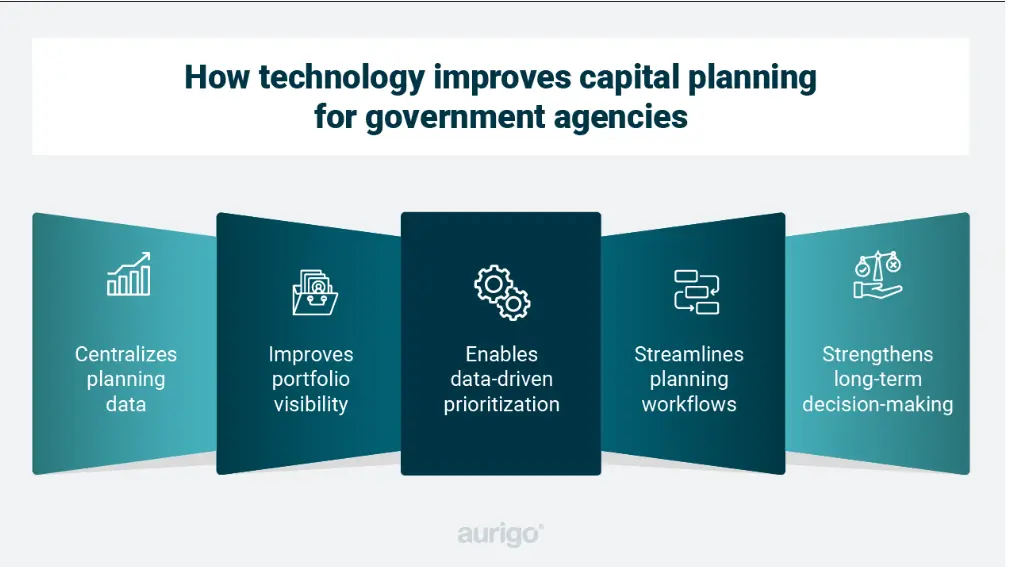
Technology is transforming capital planning from a fragmented, retrospective process into a connected, forward-looking discipline. By integrating data, analytics, and real-time visibility, organizations can prioritize investments more effectively and improve outcomes across complex capital programs.


Do you have several capital construction and improvement projects in the pipeline? Are you at a crossroads between the right program selection and prioritization? Capital planning is complex and no easy feat to achieve. There is a risk that costs will exceed the allocated budget and that capital improvement programs will exceed the scheduled timeline. Legal compliance, project-specific cash flow tracking, and ensuring the smooth execution of capital construction projects and programs can be daunting when you rely on homegrown systems and Excel.
As a capital owner, you can leverage a robust cloud-based capital planning solution to plan and build infrastructure effectively. From deciding the scope of the project, its prioritization, budget and fund management, what-if analysis, and derived insights to approvals, a good capital planning software solution enables you to manage these activities on a single platform. Investing in the right software solution ultimately increases productivity, eliminates errors, reduces rework, and alleviates stress among team members.
Benefits of capital planning solutions
Project prioritization
How do you select the right capital projects while ensuring objectivity and transparency in the process that does not rely on individual opinions? A good capital planning software solution offers an automated project prioritization system backed by a criteria-based scoring mechanism. It helps to create a scoring matrix based on your agency’s strategic goals. Key stakeholders can access the right background information for every project and provide input electronically. Plans can be easily routed for approval, creating an automatic audit trail. You can use historical data to justify your project choices. Configurable reports and dashboards allow for objective, data-driven decisions, enabling you to build a multiyear capital plan confidently.
Budget and forecasting
When looking at your agency’s multiyear capital plan, you will need accurate data for a high-level view of your CIP (Capital Improvement Plan) as well as details of individual projects. A powerful capital planning software solution will provide you with dashboards built on multiple data points, simplifying your capital fund management. It will give you a clear picture of funding sources and fiscal limitations. Reporting funnels will show projects in various stages, from inception to execution. With this capability, your agency can easily track the money tied to each project and see predictive cash flow. With the right capital planning tools, you can create multiyear cash flow analyses and contingency plans in line with inflation and interest capitalization over the entire capital program. Forecasting capabilities enable agencies to plan more effectively and remain within budget without overshooting.
What-if analysis
What-if analysis is a popular technique used to predict how a capital program will change based on various scenarios or variables. It is a structured way to brainstorm and understand the risks associated with the current plan and explore alternate solutions. What-if analysis can also be considered a risk management method. You can easily modify and update data to create multiple versions of the same program and choose the right plan to meet your strategic goals.
Unified system
Capital programs and project management have complexities that regular project management software cannot support. Using a centralized construction capital planning system enables you to consider your agency’s priorities, costs, risks, and impact analysis, helping you put your budget to the best use. Working with the most up-to-date data allows you to create and approve multiyear plans confidently. The right capital planning software solution also helps you streamline your organization’s downstream processes by acting as a single system that handles all planning activities from estimation to project approval, including design review, bidding, procurement, and construction. You can easily monitor the health of your plan and spot any potential red flags as soon as possible.
Easy and on-time approvals and tracking
Gaining approval for capital programs involves communicating with stakeholders of different levels of seniority, knowledge, and expertise. This can make securing on-time approvals challenging to achieve. A capital planning software system simplifies the project-approval process by keeping you up to date on the current approval steps and hosting all change requests in a centralized repository. Automated workflow task notifications send reminders to the right stakeholders to expedite approval and achieve greater transparency with real-time change order statuses. Electronic signature integrations, like DocuSign, ensure paperless approvals for funding documents that require originals.

Community engagement
Managing a capital program for your agency will invariably require public feedback on capital plans and infrastructure projects. When received during the planning phase, public feedback improves the project design and performance. In this age of technology, public engagement should be more precise, concise, and user-friendly. Leveraging an all-in-one capital planning solution with integrated social tools helps you get maximum engagement. With the click of a button, the public can access information that allows them to assess the impact of proposed projects. Modern cloud-based capital planning tools have artificial intelligence and sentiment analysis that make data collection less time-consuming and more systematic. Such tools eliminate a considerable amount of time spent processing and understanding information received, offer real-time analysis, and provide consistent data across projects.
Project data format consistency
As a capital owner, you may have experienced the hassles of disjointed, decentralized systems and data scattered across various platforms. The capital planning process involves several projects with complex data, which often outgrow what Excel can provide. A capital planning software solution requires projects to be submitted in a consistent format. This saves time and effort and reduces costs, making it easier to find relevant or missing information and eliminating the need for manual effort to access critical project data.
Easy collabration between stakeholders
Conventionally, most capital owners and capital planning organizations rely on homegrown management systems for capital planning and scattered data for decision-making. A good capital planning software solution can easily integrate with your existing project management systems, financial systems, and data warehouse solution and host several additional features on a single platform, such as ESRI/GIS mapping and electronic signatures. An integrated system keeps internal teams and external stakeholders, such as contractors, consultants, and inspectors, updated on plans, documents, and changes. With role-based permissions, users can only access the required information, thereby keeping their data secure and confidential.
Document management
You might like


Frequently asked questions
Why is technology becoming essential in modern capital planning?
Capital planning today requires navigating complexity across funding, risk, and long-term strategy. Traditional methods lack the visibility and adaptability needed to manage interconnected programs. Technology introduces structure and real-time insight, enabling organizations to move from reactive decision-making to proactive, portfolio-level planning.
How does technology improve decision-making in capital programs?
Technology consolidates financial, operational, and project data into a unified environment, allowing leaders to evaluate trade-offs and monitor performance continuously. This integrated view supports more informed prioritization, better risk management, and stronger alignment between strategic objectives and capital allocation.
What long-term impact does digital capital planning have on organizations?
Over time, digital planning environments create institutional discipline. Organizations gain the ability to adapt to changing conditions, improve transparency, and deliver projects with greater predictability. This shift strengthens governance while enabling more efficient use of capital across multiyear investment programs.