

Blog
Ways to use technology to improve labor management
Technology is transforming labor management from reactive scheduling to proactive workforce planning. With real-time visibility and data-driven insights, organizations can optimize resource allocation, improve productivity, and respond more effectively to changing project demands.


Labor management encompasses the strategic planning, organizing, and managing of the workforce to effectively accomplish project objectives within predefined time frames, budgets, and quality standards. One of the crucial factors in delivering a large, complex project on time is managing the labor force efficiently. Currently, the construction industry faces a significant challenge in securing highly skilled workers due to high demand and intense competition, necessitating the adoption of digital technology to optimize workforce productivity and achieve project success. By investing in the right set of tools, agencies can achieve key benefits, such as efficient workforce management, minimized labor costs, and improved project delivery outcomes.
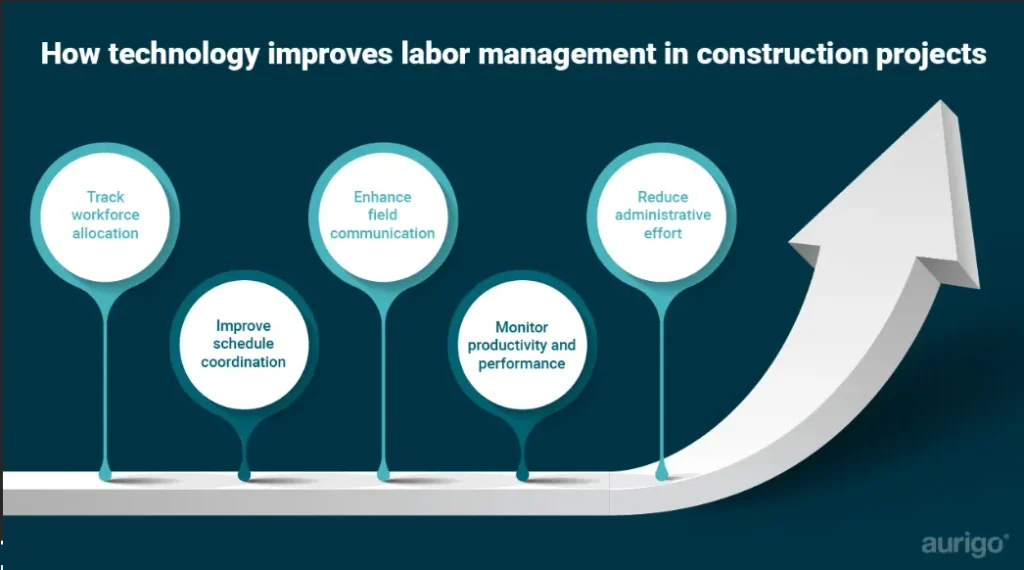
Here is how technology can help improve labor management
Reduce large dependency on a skilled workforce
Being a labor-intensive industry, construction usually suffers from high project costs and time overruns due to the shortage of qualified staff. Cloud-based, AI-driven construction management software solutions help in planning, building, tracking, and managing assets, infrastructure, as well as facilities. They efficiently handle every phase of the construction life cycle, thereby reducing the need for manual hours. Using drones to inspect sites with high risks, instead of relying on an expert, saves time and resources for the entire project. Other examples of using digital tools to reduce dependency on labor and improve inventory management are GPS tracking and RFID tags.
Improve resource management and allocation
There is an increasing need to identify strategies and develop tools to optimize the existing workforce and improve efficiency and productivity. Construction resource management software solutions use AI/ML models to distribute human resources across project activities. Regression analysis is utilized to identify the most prognostic factors for workforce requirements. Predictive models combined with regression analysis that use filter and wrapper methods help estimate labor needs and capacity planning.
Enhance communication and collaboration
Collaboration is a vital part of labor management in construction. Successfully delivering a project requires the entire team to be equally informed and united. According to a study, “91% of contractors and owners agree that increased collaboration reduces risk on construction projects.” Embracing a construction management software solution that provides a single source of truth for cross-functional collaboration and information sharing allows all stakeholders easy access to project data.
When implemented by your organization and integrated into your team’s mobile devices and central computer system, such software solutions keep all departments connected, be it the construction site or a back-end office, and make real-time communication feasible. These solutions reduce unnecessary time spent collecting accurate data, eliminate frustration caused by miscommunication and data loss, and help clarify an issue or obtain timely approvals. In other words, digital platforms speed up communication, thus accelerating project delivery.

Ensure jobsite safety
Safety considerations should be the first step in any construction project. Poor safety protocols prevent the team from adequately executing their duties and responsibilities, slowing the process. The construction industry in the United States has around 7.2 million workers. Many consider it one of the most dangerous industries due to the high rates of accidents and injuries. The top causes of fatalities in construction are falls, caught-in or -between hazards, struck-by incidents, and electrocution. The CDC notes that over 36% of construction worker fatalities result from falls.
Owners must ensure that working conditions adhere to Occupational Safety and Health Administration (OSHA) recommendations and provide suggested training for their workers. They are also responsible for enforcing and maintaining appropriate Personal Protective Equipment (PPE) on the construction site. Most construction injuries and deaths are preventable if workers wear proper PPE, such as hard hats and safety vests. However, monitoring workers on-site for PPE compliance is expensive, time-consuming, and resource-intensive. One way to automate the detection of safety gear is to use Computer Vision (CV) models that can process images of construction sites and ascertain safety violations, such as workers not wearing hard hats or safety vests. Upon detecting violations, these models can notify relevant stakeholders so that they enforce OSHA regulations effectively. This automated safety gear system can reduce fatalities, increase worker security, and save costs by preventing accidents that may result in work stoppages.
Streamline payment process
Large construction projects require large teams and labor forces. Union requirements can also increase the challenges associated with the payment process. In the worst cases, errors, disputes, and poor labor relations could lead to further action by the union, including strikes. The convenience of using construction resource management software solutions, whether on a mobile phone, an iPad, or other handheld devices, makes it easy for people in the field to keep track of the employees’ working hours, access information, manage inspections, and make real-time updates. This minimizes paperwork, streamlines the payment process, and helps comply with local union guidelines.
Monitor health and wellbeing
Construction workers may need to work overtime to stay on schedule and meet deadlines. This need can become aggravated due to the workforce shortage. Although employees may appreciate the opportunity to get bonuses, they may neglect their mental and physical wellbeing. Therefore, it is essential to monitor employee health and have a plan to incentivize it. A healthy and fit workforce is less prone to accidents and more productive. According to a National Safety Council survey, “90% of American employers have been negatively impacted by tired employees.”
In addition, wearable tech allows for early recognition and intervention when employees struggle with fatigue. For example, a sensor can be mounted on construction workers’ helmets to collect data, such as temperature, humidity, and UV exposure, and track their exhaustion. In addition, other wearable devices, such as wristbands, can also help monitor construction workers’ health. Such gadgets allow field workers to report how daily activities in the field impact them and the general mood of the site (aggressive, peaceful, or calm), and stakeholders can use this data to prevent over-exhaustion and enhance productivity.
You might like




Frequently asked questions
Why is labor management a critical challenge in construction and infrastructure projects?
Labor is one of the most dynamic and constrained resources in project delivery. Fluctuating demand, limited skilled workforce availability, and coordination across multiple projects make it difficult to maintain efficiency without structured planning and visibility.
What limitations do traditional labor management approaches create?
Manual scheduling and disconnected systems often result in inefficient resource allocation, limited visibility into workforce utilization, and delayed responses to changing project conditions. These gaps can lead to productivity losses and project delays.
How does technology improve labor management outcomes?
Technology enables real-time tracking, better forecasting, and centralized workforce planning. By connecting labor data with project schedules and performance metrics, organizations can optimize resource allocation, improve productivity, and maintain control across complex programs.