
Blog
Is your capital planning ready for the future of retail?
Retail and warehouse operators must replace gut-driven, fragmented capital planning with AI-powered, data-driven portfolio management to keep pace with rising costs, tighter timelines, omnichannel expansion, and constant market volatility.


Retail owners, developers, and facility operators face increasing pressure to upgrade their facilities quickly and meet heightened expectations. As customer acquisition costs have surged by 222% over the past decade, there’s a shrinking tolerance for mistakes in capital planning. With stakes this high, 92% of executives still admit to using a dangerously outdated compass—their gut feeling.
The cost? Supply chain professionals spend two full workdays each week manually tracking data. This waste stems from a broken, reactive planning process and is a symptom of the broader pressures reshaping how retailers and warehouse operators plan, build, and invest.
It’s a problem that legacy tools can’t solve, but one for which modern capital planning software is designed to address.
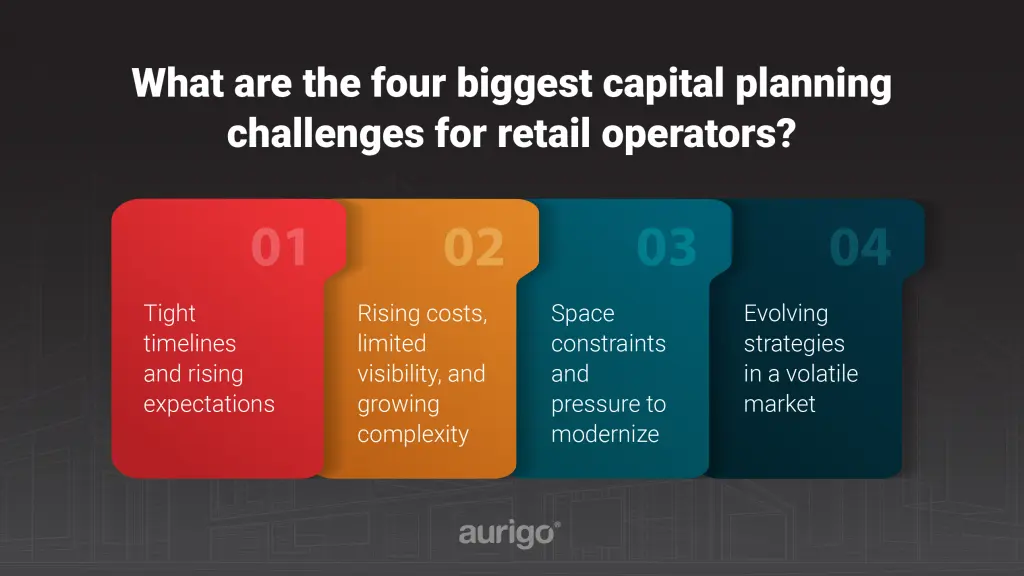
Four capital planning challenges every retail operator faces
1. Tight schedules and rising expectations
Surging demand and rising consumer expectations for speed are driving retail and warehouse operators to accelerate at an unprecedented rate. As U.S. e-commerce sales are projected to reach $1.7 trillion by 2028, speed has become the defining metric for success. By 2029, consumers will expect two-thirds of deliveries to arrive the same day or the next, leaving no room for delay. Even small setbacks can have major consequences, 65% of customers are likely to abandon a retailer after just two or three late deliveries. This fragile loyalty was tested during the 2024 peak season, when 58% of companies reported system failures under load, resulting in millions of dollars in lost revenue and long-term brand damage.
2. Rising costs, limited visibility, and mounting complexity
Today, operators fight a two-front war against advancing costs and internal complexity. Externally, project budgets are under attack from rising costs, with U.S. construction input prices rising at an annualized rate of 6%. Internally, slow, siloed decision-making constrains retailers, with teams operating on different timelines. This fragmentation makes it difficult to align investments with growth targets. With projects spread across multiple regions, partners, and funding sources, leaders struggle to forecast confidently and pivot when market conditions change.
A 2025 Deloitte report highlights another key challenge: ‘tech debt,’ where legacy systems limit agility and delay data-driven decisions. As costs balloon and budgets tighten, operators must rely on advanced ROI modeling and forecasting to ensure every dollar delivers value.
3. Space constraints and the race to modernize
Research shows that companies with strong omnichannel strategies retain 89% of their customers, compared to 33% for those without, and enjoy shoppers with a 30% higher lifetime value. The financial incentive to enhance infrastructure has never been greater.Recognizing this trend, 85% of retailers planned to upgrade their fulfillment infrastructure in 2024. Yet, executing these critical upgrades is becoming increasingly challenging due to mounting pressures in the real estate and construction sectors.
Online sales now demand far more physical space, requiring roughly three times the warehouse area per sales dollar compared to traditional retail. This need for additional square footage is colliding with soaring construction and retrofit costs. At the same time, record-low industrial vacancy rates and rising land costs are tightening the window of opportunity for expansion. Securing suitable sites now requires proactive retail capital planning and modeling to assess trade-offs before market conditions shift, separating forward-thinking operators from those who react too late.
Many expansion and retrofit programs also stall because core systems, including finance, construction, and facilities, operate in isolation. Without modern capital planning software to provide a unified view of project data, decisions lag behind field progress. As a result, budgets slip, projects lose momentum, and teams find it harder to react quickly to change.
4. Shifting strategies in an era of volatility
Today, operators face a volatile environment that is forcing a rethink of long-held strategies. In response to supply chain shocks, 78% of firms have adopted ‘just-in-case’ inventory. At the same time, the explosive growth of Buy Online, Pick Up In-Store (BOPIS) highlights dramatic shifts in consumer behavior. These market shifts underscore the need for swift, informed, and adaptable capital planning systems that enable operators to respond with data-driven agility. As automation becomes central to fulfillment, leaders need dynamic tools that can model ROI, forecast scenarios, and align spending with strategic business goals.
Unlock speed, precision, and profitability with AI-powered capital planning software
In a market defined by constant disruption, retail and warehouse operators require a data-driven, AI-powered capital planning software, such as Aurigo Primus that enables them to plan smarter, invest confidently, and adapt quickly as conditions change. Instead of relying on gut feel, teams can model different funding strategies, evaluate trade-offs, and prioritize the right projects at the right time.
Primus enables this through AI-powered tools, such as strategic project scoring, what-if analysis, and real-time fiscal tracking, ensuring every dollar delivers measurable ROI. It also connects portfolio planning with execution by continuously syncing field data, budgets, and forecasts. This unified view ensures cost control, eliminates data silos, and keeps plans accurate in real time.
The result is stronger teams that scale effortlessly while remaining fast, precise, and dependable. This translates to faster store openings, improved fulfillment readiness, and confident modernization across your portfolio.
Learn more about Aurigo Primus and request a demo today.
You might like

Frequently asked questions
What are the biggest challenges facing capital planning in the future of retail?
Retail and warehouse operators face tight timelines, rising customer expectations, rising costs, and internal complexity, all of which make traditional planning methods inadequate. These pressures demand smarter forecasting, real-time visibility, and unified data to align investments with growth goals and avoid costly delays.
Why is modern capital planning important for retail infrastructure upgrades?
As e-commerce growth accelerates and consumer expectations for rapid delivery rise, retail owners must strategically modernize fulfillment and store infrastructure. Modern capital planning enables real-time scenario analysis, better cost forecasting, and alignment of multi-site investments, reducing risk and improving speed to market.
How can AI-powered capital planning software help retail operators prepare for future demands?
AI-enabled capital planning tools help retail owners model different funding strategies, prioritize the highest-impact projects, assess trade-offs, and connect planning with execution through real-time data. This data-driven approach replaces reactive decision-making and supports confident investments that improve delivery readiness and customer satisfaction