
Blog
How digital tools are transforming real property management for government agencies
Digital tools are reshaping real property management by replacing fragmented, manual processes with connected, data-driven systems. Agencies gain improved visibility into assets, streamline operations, and make more informed decisions across property portfolios.


Managing real property—whether buildings owned for decades or land recently acquired through capital projects and right of way acquisitions—requires more than spreadsheets and legacy systems. Disconnected data, manual workflows, and paper-based processes slow approvals, obscure lease tracking, and increase compliance risks. Without a centralized, digital approach, agencies struggle to maintain visibility into assets, agreements, and obligations, making oversight and strategic planning difficult.
To drive better outcomes and improve efficiency, agencies need a unified platform that centralizes all information related to ownership, leasing, operation, maintenance, improvement, and disposition of properties. This consolidation enables real-time access, accelerates processes, and empowers stakeholders to make faster, better-informed decisions across the entire property portfolio.
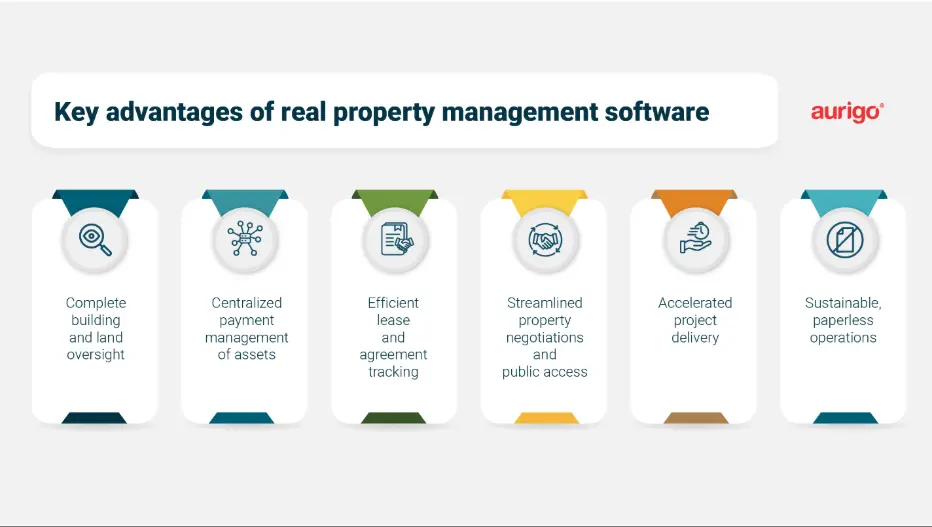
Benefits of real property management software
Gain complete visibility across all assets
Centralize budgets, payments, and financial oversight
A real property system integrates directly with financial platforms to support asset funding and payment management. Users can submit fund requests through configurable workflows with defined approval paths and audit trails. Each payment can be associated with specific property numbers or assets, whether for land purchases, leases, or easements. Agencies can also track detailed property information, including site address, in-service date, site name, property type, Public Land Survey System [PLSS] coordinates, and Assessor’s Parcel Numbers [APNs] tied to tax and ownership records.
Payment fields are added directly to building and parcel forms, and authorized users can maintain or update data. The software also allows users to track all expenditures by property number throughout the project lifecycle. Reports comparing budgeted, committed, and actual spend support financial accountability and better forecasting. Dashboards offer KPI tracking, scenario analysis, and asset appreciation insights to guide decision-making and maximize investment outcomes.
Streamline lease management and compliance
Lease and agreement tracking becomes far more efficient with structured, digital workflows. Agencies can monitor lease start and end dates, associated costs, and involved parties through configurable forms and workflows. Authorized users can input or edit agreement terms until final approval, after which changes follow a defined change order process, preserving data integrity and compliance. Track clauses, costs, and overrides while securely storing long-term financial and legal documentation, with role-based permissions to control access to data.
Auto-reminders prevent missed renewals, bulk actions streamline multi-lease updates, and benchmarking tools help compare costs and terms across agreements. The platform fully supports lease management, including the ability to link multiple leases with a single property.
Simplify property negotiations and improve public access
Managing complex negotiations and legal processes is easier with a digital system that centralizes every step, from owner engagement to contract closeout. Teams can initiate negotiations, track parcel and appraisal data, collaborate with external legal counsel, and generate contract negotiation reports—all within one platform. Templates, automated approval workflows, and e-signature capabilities help reduce manual effort and accelerate approvals.
To improve community access and ease staff workload, a secure public-facing portal can be deployed to submit easement, lease, and license requests. External stakeholders, including consultants and landowners, can generate and download pre-configured reports without needing system credentials. Agencies control what information is shared, ensuring secure, on-demand access while maintaining confidentiality.
Accelerate projects with smart planning tools
Starting new projects becomes faster with configurable templates for specific contract types. These templates include pre-defined workflows, document requirements, and approval logic to ensure consistency and reduce manual errors. Work breakdown structures (WBS) allow teams to organize projects into multiple levels, such as program, phase, task, activity, sub-activity, parcel, sub-parcel, county, and city. This enables clear assignment of responsibilities and progress tracking at every stage.
Project matrices and tables make it easier to visualize dependencies, timelines, and resource allocations. Built-in scheduling tools help plan, monitor, and report on project milestones, while real-time dashboards keep all stakeholders aligned and informed.
Reduce environmental impact and support digital transformation
Real property management software directly contributes to sustainability goals by replacing paper-based processes with digital workflows. By digitizing contracts, approvals, and recordkeeping, agencies can minimize paper usage, promoting greener, more environmentally responsible operations. Online submission portals, electronic signatures, and automated notifications eliminate the need for physical documents. These tools also reduce manual handling across departments and external partners. Every interaction, from lease generation to contract approval, can be completed digitally, accelerating processes while reducing waste.
Final thoughts
Effective land and asset management demands more than simple tracking. It requires streamlined processes, regulatory compliance, and full transparency. With Masterworks Real Property Management, government agencies can reduce administrative burden, accelerate workflows, and ensure responsible stewardship of public assets—delivering greater value to the communities they serve.
You might like

Frequently asked questions
Why is real property management becoming more complex for government agencies?
Government agencies manage diverse property portfolios with evolving regulatory, financial, and operational requirements. Without centralized systems, it becomes difficult to maintain visibility, ensure compliance, and align property decisions with broader strategic goals.
What limitations do traditional property management approaches create?
Manual processes and disconnected systems limit visibility into asset performance, lease data, and financial metrics. This fragmentation makes it harder to track utilization, manage risks, and make timely, informed decisions.
How do digital tools improve real property management outcomes?
Digital platforms centralize asset data, automate workflows, and provide real-time insights into property performance. This enables agencies to optimize asset utilization, improve compliance, and make data-driven decisions across their portfolios.